The Polyptych of the Janelas Verdes
A journey into the past through art, history and discovery.
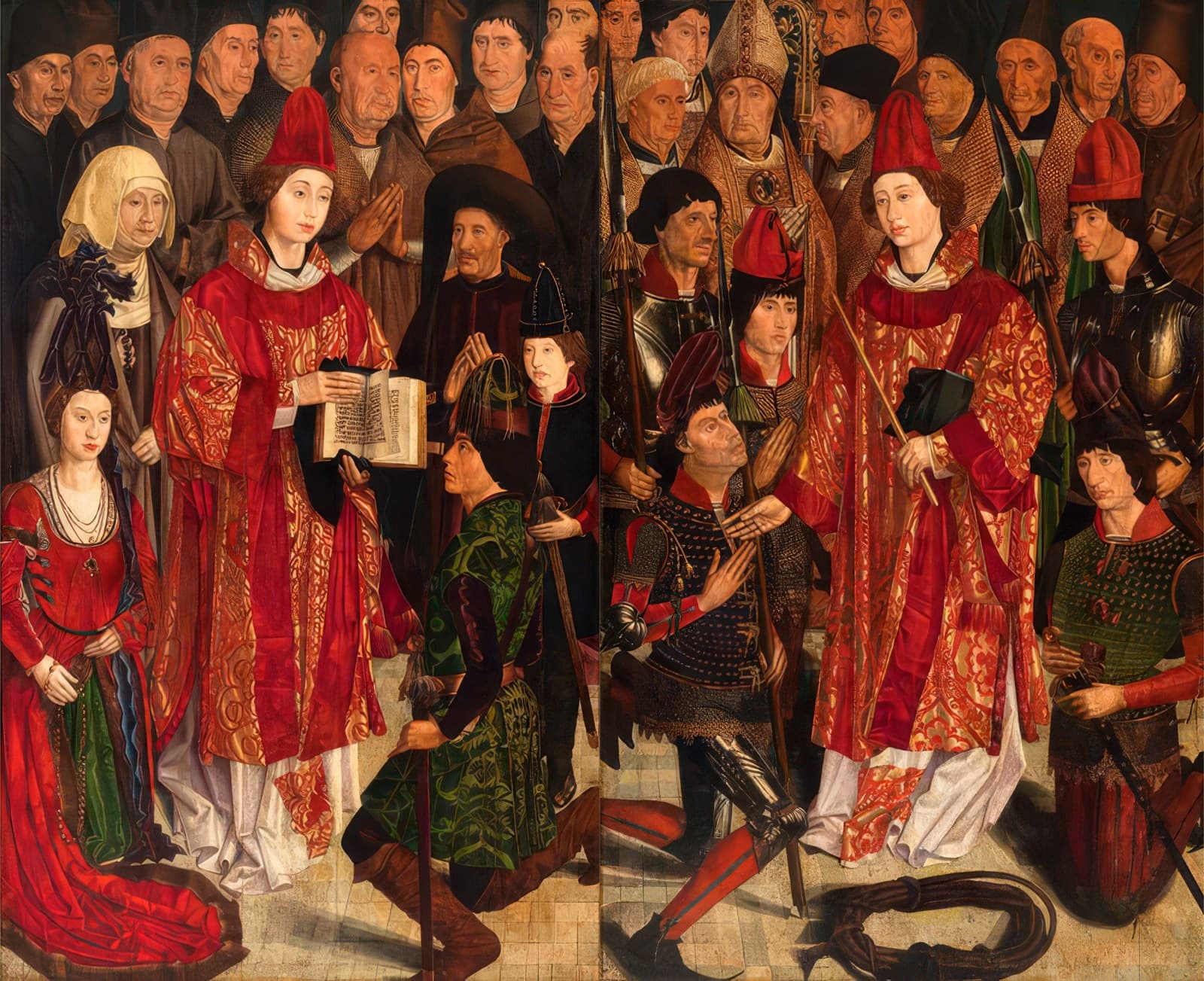
Central panels — the dual figure, haloed, with the book and the staff, made manifest on both sides of the axis.
It is not “Saint Vincent”.
It is the Polyptych of the Janelas Verdes — the place where it physically resides. The title questions without answering, and that is precisely the point of departure of this exhibition.
The Emperor of the Last Days and the End of History
It is the purpose of this exhibition to reappraise one of the most fascinating and contentious subjects in the nation's history and culture, from the moment of its rescue from oblivion, at the hand of Monsignor Alfredo Elviro dos Santos, in the Patriarchal Palace of São Vicente de Fora, in the year 1882.
It is, of course, the work — so christened by Jaime Cortesão in the 1950s — the Polyptych of the Investiture of the Nation in the Mission of the Holy Spirit, commonly known as the Polyptych of the Janelas Verdes.
Opening programme
10 June 2026
- Presentation17H00
- Inauguration17H30
- Cocktail18H30
Fifty-eight figures gathered around a mysterious figure
The six panels that make up the Polyptych depict 58 figures, representative of the Portuguese and Burgundian Courts and of the various strata of their respective fifteenth-century societies, gathered in a monumental and solemn assembly. They are arranged around a mysterious figure, twofold (2), haloed, vested in a red dalmatic and bearing complementary attributes, manifested in both central panels.
The Polyptych obeys a rigorous symmetry, with thirty figures (17 + 13) on each side of the central vertical axis, distributed across three panels — one large and two smaller.
Six panels, rigorous symmetry
Sixty figures (30 + 30) around the central vertical axis. The horizontal axis divides each group of 30 into 17 and 13.
What science revealed
The most recent campaigns of restoration, conservation and scientific research have brought fresh perspectives on one of the most enigmatic works in Portuguese art.
Dendrochronology
Painted in oil and tempera on 25 boards of Baltic oak. Analysis of the last growth ring, carried out in 2002, revealed an interval of 48 years (1383–1431).
Radiography
It reveals an earlier layer beneath the visible one: the painting we see today rectifies a previous composition.
Four restorations
When, in 1909, Luciano Freire reintegrated the Polyptych, it had already been the object of four interventions over the centuries — someone had it in their keeping and kept it on view, providing the necessary care.
Credited to Nuno Gonçalves
As early as 1910, and on the basis of the vague information of Francisco de Holanda, José de Figueiredo addressed the problem of the Polyptych's authorship. Weaknesses were immediately pointed out in his thesis, arising from the lack of knowledge of documents revealed only later, as well as from the absence of the examinations undertaken only in the late twentieth century.
The authorship of the panels was credited to Nuno Gonçalves on the basis of the interpretation of a monogram detected on the boot of the kneeling figure in the Panel of the Prince, revealed during a restoration of the painting in the 1930s, and which was taken to coincide with other signatures used by the same artist in contemporary documents and works.
“The finest document was always publicly on view, in the only surviving element of the whole work: the six boards.”
“An author, in conveying a message — as is the case with the author of the Polyptych — cannot but “care” about the proper way of making it communicate.”
Almada Negreiros
Complementary readings, not rival ones
Over the decades, the identity of the dual figure has received successive interpretations — not rival, but complementary.
Jaime Cortesão
1965
Investiture of the Nation in the Mission of the Holy Spirit
The name that took hold — the nation invested in the Mission of the Holy Spirit.
José Luís Conceição Silva
1981
Herald of the Age of the Holy Spirit
The figure that announces the advent of the Age of the Holy Spirit.
Manuel J. Gandra
1981
Melchizedek, King and Priest
King (temporal power) and priest (spiritual authority), in the image of Melchizedek.
Lima de Freitas
1993
515 — Il Messo di Dio
The Dantean apocalyptic cipher — the envoy of God.
And what if the Polyptych were nothing more than a heterodox, perhaps heretical, indictment, whose message became obsolete and unintelligible to the collective memory from the sixteenth century onwards? And what if it enclosed a prophecy yet to be fulfilled in the future, referring to no past event — Alfarrobeira, the Captivity and the martyrdom of the Saintly Prince?
Professor Manuel J. Gandra
More than an exhibition, an evocation of Portugal's deep identity — the essence of a nation that is more than it appears to be.
Book a group visit→