THE PORTUGUESE GOSPEL
Hierophanic events, such as the one depicted in the Polyptych, with explicit reference to the doctrine of the Two Swords (that of the right, or Spiritual Authority; that of the left, or Temporal Power), were frequently the object of commentary in Portugal, inasmuch as they upheld the national Ghibelline tradition, according to which “Power comes directly from God, not from the Bishop of Rome”.
A crucial question is that of determining who conceived the iconographic programme of the Polyptych.
It is beyond dispute that the work under consideration resulted from a meticulous project, matured over a long period of time, and subject to revisions, as may be inferred from the underlying drawing.
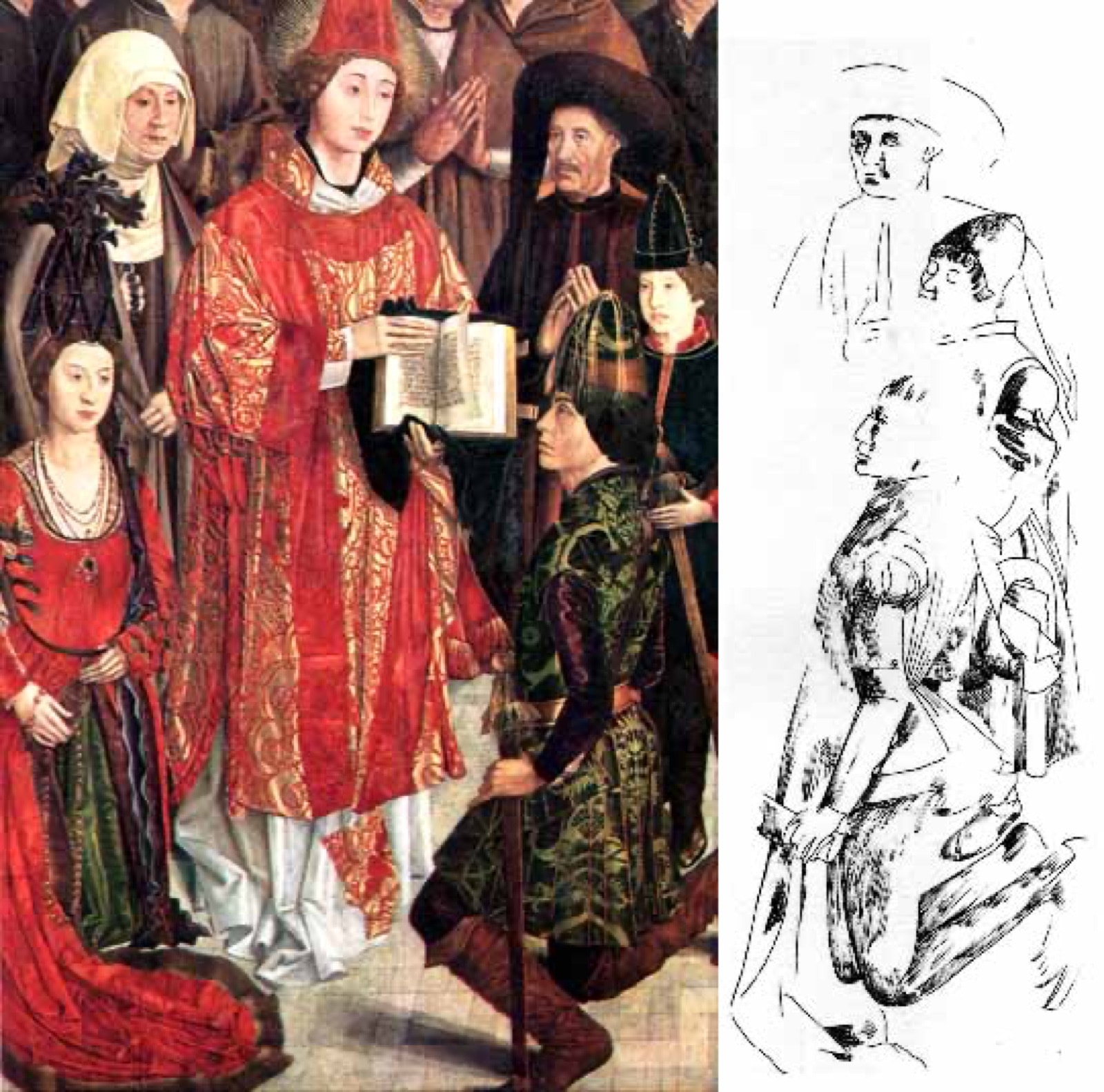
In a preparatory drawing underlying King Afonso V, a figure is observed kneeling on both knees, holding a document in the left hand
The majority of authors who have addressed the subject point to a meaning related to past events in association with the early phase of King Afonso V’s reign, disregarding and dismissing the monarch’s visionary, eschatological and hermetic convictions, which certainly informed his iconographic choices.
The message set forth in the Polyptych is threefold:
1. to demonstrate the communion of ideals (symbolised by the bundle of knotted cords = agrees with us) between the Kingdoms of Portugal and Burgundy.
2. to announce the imminence of a Hierophany, legitimising the fulfilment of the mission to redeem the World by the House of Avis (of Portugal and of Burgundy), predestined for such a purpose.
3. to enthrone Gonçalo Fernandes, his son by D. Joana de Trastâmara, the Excellent Lady, heiress to the throne of Castile, as Emperor of the Spains, a wish made manifest in the device upon the King’s right boot and concealed upon the right boot of the Child.
Such divine delegation (reiterating the Christophany of Ourique) would be auxiliary to a Prophecy realisable in a not-too-distant future, in accordance with the epilogistic calculations carried out by Afonso V himself.
The unexpected death of Charles and the extinction of the Duchy of Burgundy as an Independent State made it clear to King Afonso that, henceforth, the mission leading to the advent of the Universal Empire would depend exclusively upon the monarchs of the Kingdom of Portugal, and no longer during his own generation, but in that of his descendants at an indeterminate future, whence he abdicated the throne with the intention of departing for the Holy Land.
The liturgy of the celebrations in praise of the Empire of the Divine Holy Spirit, anticipating the advent of the Fifth Universal Empire, constituted the fitting devotional formula, and was for that reason the one adopted in the Polyptych: in the red colour of the dalmatic of “the Saint” and in the texts inscribed in the open book which he presents, alluding to the Mass of Pentecost Sunday.
It is worth recalling that Afonso V was the monarch who most protected the Brotherhoods of the Holy Spirit.
The closed book in the panel of the Archbishop (to the right of the observer, the left of the panel), whose content was secret, is now re-vealed. The right hand of “the Saint” touches the breast of Charles the Bold, as if to signal that the content of the closed book (the secret) also concerns him. But the re-velation is still partial because, in the panel of the Prince, the right hand of “the Saint” conceals certain words, as if to suggest that the principal subject of the Polyptych remains hidden.
The origin of the extracts in the book is identifiable by the legible words:
that of the 1st folio belongs to the Gospel of St John (XIV, 28-31)
that of the 2nd was taken from the Preface of the Mass of the Holy Spirit
that of the 3rd is “an excerpt from the prayer of Saint Ambrose (Oratio Sanchti Ambrosii Episcopi) recited on Saturday before Mass (Ante Missam), included in the Orationes Pro Opportunitate Sacerdotis Ante Celebrationem et Communionem Dicendae.”
Thus reads the 1st folio:
“Pater maior me est et nunc dixi vobis priusquam fiat ut cum factum fuerit credatis iam non multa loquar vobiscum venitenim princeps mundi huius et in me non habet quicquam sed utcognoscat mundus quia diligo Patrem et sicut mandatum”.
“The Father is greater than I. And now I have told you before it come to pass, that, when it is come to pass, ye might believe. I will not now speak many things with you; for the prince of this world cometh, and hath nothing in me; but that the world may know that I love the Father, and as the Father gave me commandment, even so I do”.
It may be presumed that there exists an evident relationship between this text and the events which determined King Afonso’s decision to include a prophetic message in a work of art. Indeed, the text appears:
1. to corroborate the prophecy of Joachim of Fiore, according to which the Age of the Father would be greater (longer) than that of the Son.
2. to demonstrate that “the Saint”, “the envoy of God”, or 515, is not the Messiah but an agent capable of promoting and ensuring the transition from the Second Age (the Son) to the Third Age (the Holy Spirit), whose advent was foretold for after the End of Times (the End of History).
The words of Jesus of prophetic import recounted by St John in chapter XXXI of his Gospel may be interpreted as a prognosis of the events characteristic of the End of Times, marking the transition from the time of the Prince of this World to that of the World under the Grace of the Holy Spirit. The despair and frustration experienced by Afonso V in the course of his journey to France, after the death of his cousin Charles of Burgundy, fitted perfectly within the prediction of the temporary triumph of the Prince of this World, leaving undecided precisely when his inevitable defeat would occur.
It should be noted that, although it is not possible to determine with precision where the first line of the 2nd folio begins, it becomes evident that the words “Vere dignum et justum est, aequm et salutare, nos tibi semper et ubique gratias agere [...]” (“It is truly meet and just, right and availing unto salvation, that we should at all times and in all places give thanks unto Thee, O Lord, holy Father, almighty and eternal God […]”), which constitute the opening of the Preface of the Mass of the Holy Spirit and would complete it, would have made up at least two or three additional lines at the head of the folio, preceding the beginning of the legible passage:
“Domine, Sancte Pater, omnipotens aeterne Deus: per
Christum Dominum nostrum. Qui ascendens super omnes caelos,
sedensque ad dexteram tuam, promissum Spiritum Sanctum
(hodierna die) in filios adoptionis effudit. Quapropter profusis
gaudiis, totus in orbe terrarum mundus exsultat. Sed et supernae
Virtutes atque angelicae Potestates hymnum gloriae tuae concinunt,
sine fine dicentes: sanctus”.
“O Lord, holy Father, almighty and eternal God, through Jesus Christ our Lord, who, ascending above all the heavens and seating Himself at Thy right hand, poured forth (on this day) upon the children of adoption the Holy Spirit which He had promised. Wherefore, in an outpouring of joy, the whole world throughout the entire globe of the earth exults; and the very celestial Virtues and angelic Powers sing a hymn to Thy glory, repeating without end: Holy”.
As for the 2nd folio, it is found that, given its length, the selected passage was not transcribed in full, only isolated words and sequences of two words having been highlighted, which are displayed retaining their respective relative positions within the complete text:
“[...] Domine, Sancte Pater, om
nipotens aeterne Deus: per Christum Dominum
nostrum. Qui ascendens super om
nes caelos, sedensque ad dexte:
ram tuam, promissum Spiritum
Sanctum (hodierna die) in filios:
Adoptionis effudit. Quapropter p
rofusis gaudiis,totus in orbe terrarum
mundus exsultat. Sed et supernae Vir
tutes atque angelicae Potestates:
hymnum gloriae tuae concinunt, si
ne fine dicentes sanctus […].”
It should be noted that new punctuation was introduced through the use of “:” (colon), which, in the mid-fifteenth century, was used either to indicate pauses or as a separator between sentences. In this text, the colons follow “dexte:”, “filios:” and “Potestates:”
The author of the iconographic programme is thus suggesting that the text of the 2nd folio ought to be read and interpreted by recourse only to the four phrases formed by the visible words (or parts of words):
“Pater omnipotens Dominum super omnes ad dexteram”
“promissum Spiritum in filios”
“Quapropter profusis terrarum supernae Virtutes Potestates”
“concinunt sine dicentes santus”.
“Almighty Father, Lord over all, at the right hand; the Spirit promised to the children; Therefore, poured forth over the lands, the celestial Virtues and Powers; they sing without ceasing, saying holy”.
Although the word “pater” is not visible in the 1st folio, being concealed by the hand of “the Saint”, the repetition of the word “father” in the first line of the two first folios indicates to the present and future observers of the painting that the message is related to the Father (God), as the theophanic source par excellence.
In the 3rd folio:
“[…] Panis quem ego dabo, Caro mea est pro mundi vita.
Ego sum panis vivus, qui de Coelo descendi. Si quis manducaverit ex
hoc pane, vivet in aeternum. Panis dulcissime, sana palatum cordis
mei, ut sentiam suavitatem amoris tui. Sana illud ab omni languore, ut nullam praeter te sentiam dulcedinem. Panis candidissime, habens
omne delectamentum, & omnem saporem, qui nos semper reficis, &
nunquam in te deficis; comedat te cor meum, & dulcidine sapores tui
repleantur viscera animae meae. Manducat te Angelus ore pleno;
manducet te peregrinus homo pro modulo suo, me deficere possit
[… in via, tali recreatus viático]”.
“The bread that I will give is my flesh, which I will give for the life of the world; I am the living bread which came down from heaven: if any man eat of this bread, he shall live for ever […]”.
The aforementioned Age of the Paraclete pointed not merely to a Christian Empire succeeding the Roman one, but to a form of political and social organisation that privileged the supremacy of Spiritual Authority over Temporal Power.
The acceptance of such principles as tangible realities guided King Afonso V in the conception of the Polyptych, determining its most minute details, from the protagonists, united in a common devotion, to their deliberate distribution, according to predefined numbers, across the different quadrants to the right and to the left of the work.
As a result of what has been stated, the Polyptych obeys a rigorous symmetry: the sixty figures present in the scene were distributed across the six panels in a manner that obeys arithmosophic criteria and those of transcendental aesthetics, underpinned by principles of sacred geometry impossible to interpret by anyone unacquainted with the subject. On each side (left and right), 29 figures are counted around the “Messenger”, in both central panels.
Despite everything, the number 17 is the arithmosophic value that stands out, certainly on account of the epilogistic symbolism that the Christophanic Tradition of Ourique lent to it, and which King Afonso V intelligently adopted the better to legitimise his eschatological vision.
The depicted ceremony is presided over by a young man, haloed and vested in a red dalmatic, who appears to be conveying a message of the utmost importance, which is heeded with attention and respect.
Being one and the same figure, he assumes two complementary attitudes.
This is Melchizedek, the 515 (“Il Messo di Dio”, or Envoy of God and His visible Face), the King of the World, seat of the Supreme Magistracy, a figure known as Prester John in the Portuguese tradition, simultaneously Priest, on the right (the observer’s left), and King, on the left (the observer’s right).
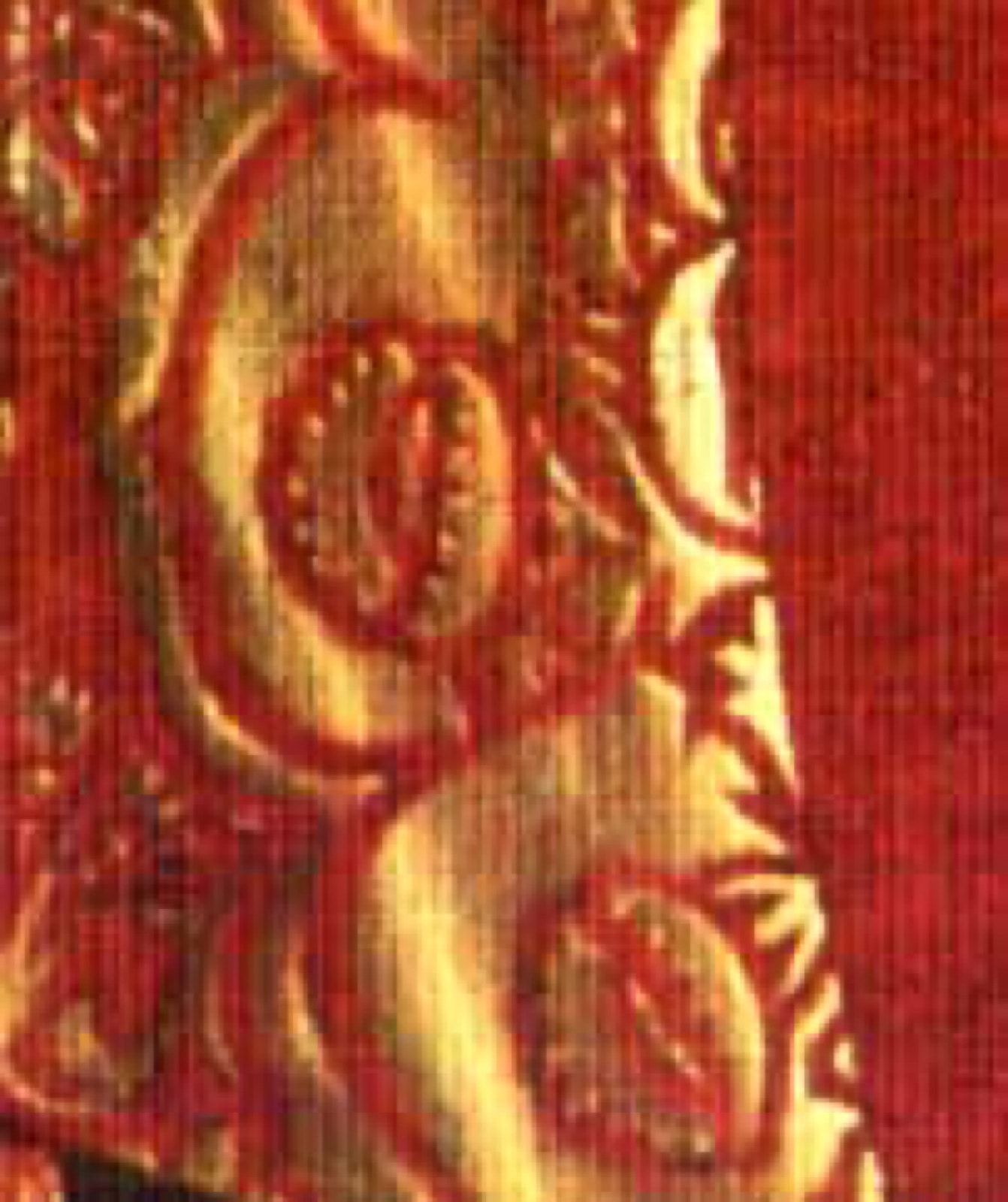
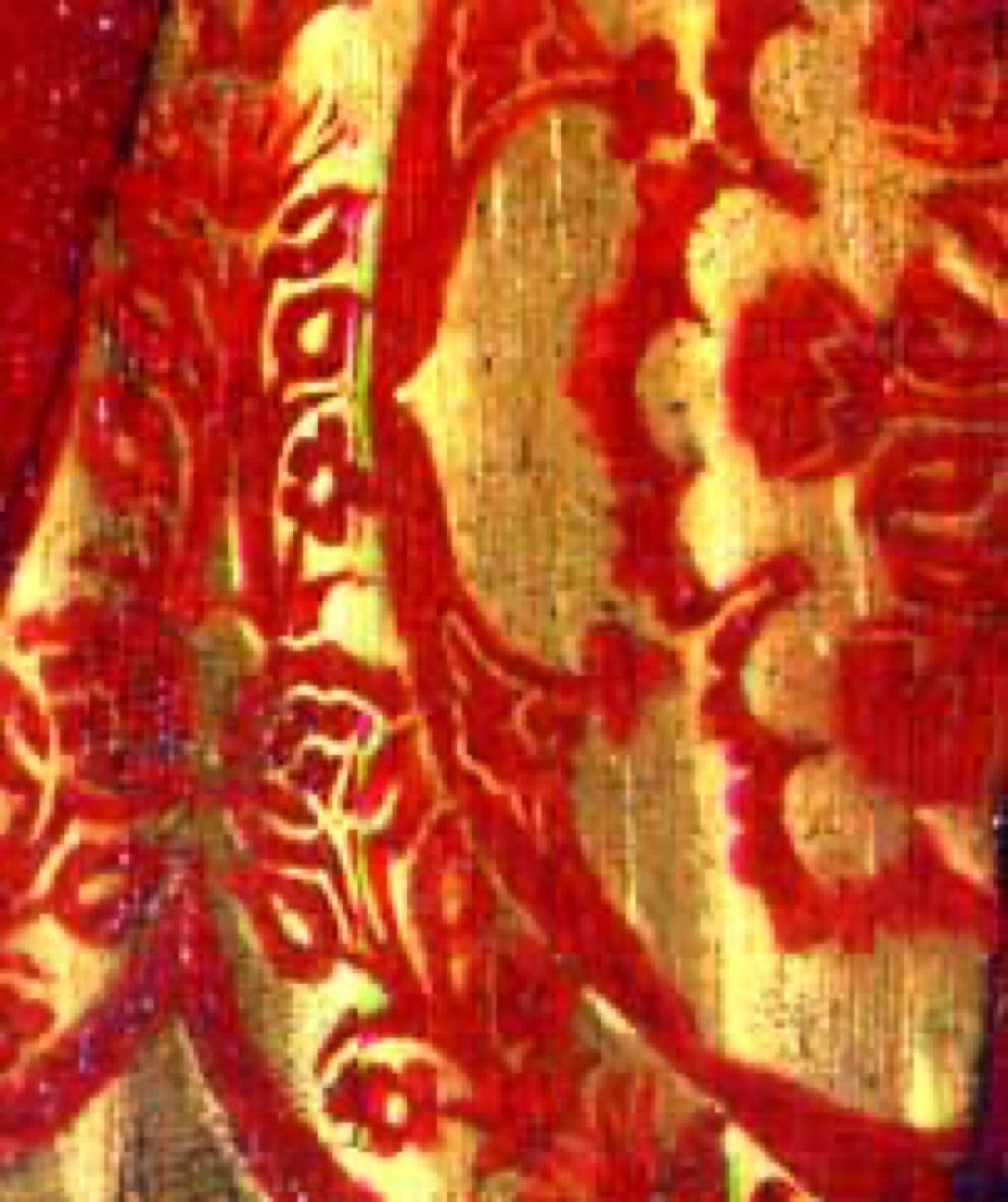
Distinct dalmatics for the two representations of the central figure:
in the right-hand panel (the observer’s left), floral buds yet to open,
in the left-hand panel (the observer’s right), a profusion of blossomed
and full-blown flowers, accompanied by rich foliage
As Priest, he officiates a Mass of Pentecost, within the scope of an Empire of the Divine Holy Spirit, as evidenced by the 3 legible folios of the open Book, in view of the assembly.
As King, however, he wields a golden rod of one cubit (45 cm), keeping the Book closed, and its content likewise hidden.
That rod of command and justice is the one with which the Envoy of God shall measure the Temple (the Celestial Jerusalem):
XI, 1-2:
And there was given me a reed like unto a rod; and the angel came, and said: Rise, and measure the temple of God, and the altar, and them that worship therein.
But the court which is without the temple leave out, and measure it not; for it is given unto the nations, and the holy city shall they tread under foot forty and two months.
XXI, 15-17:
And he that talked with me had a golden reed to measure the city, and the gates thereof, and the wall thereof.
The city lieth foursquare, the length and the breadth equal. And he measured the city with the reed, twelve thousand furlongs. The length and the breadth and the height of it are equal.
And he measured the wall thereof, an hundred and forty and four cubits, the measure of a man, that is, of an angel.
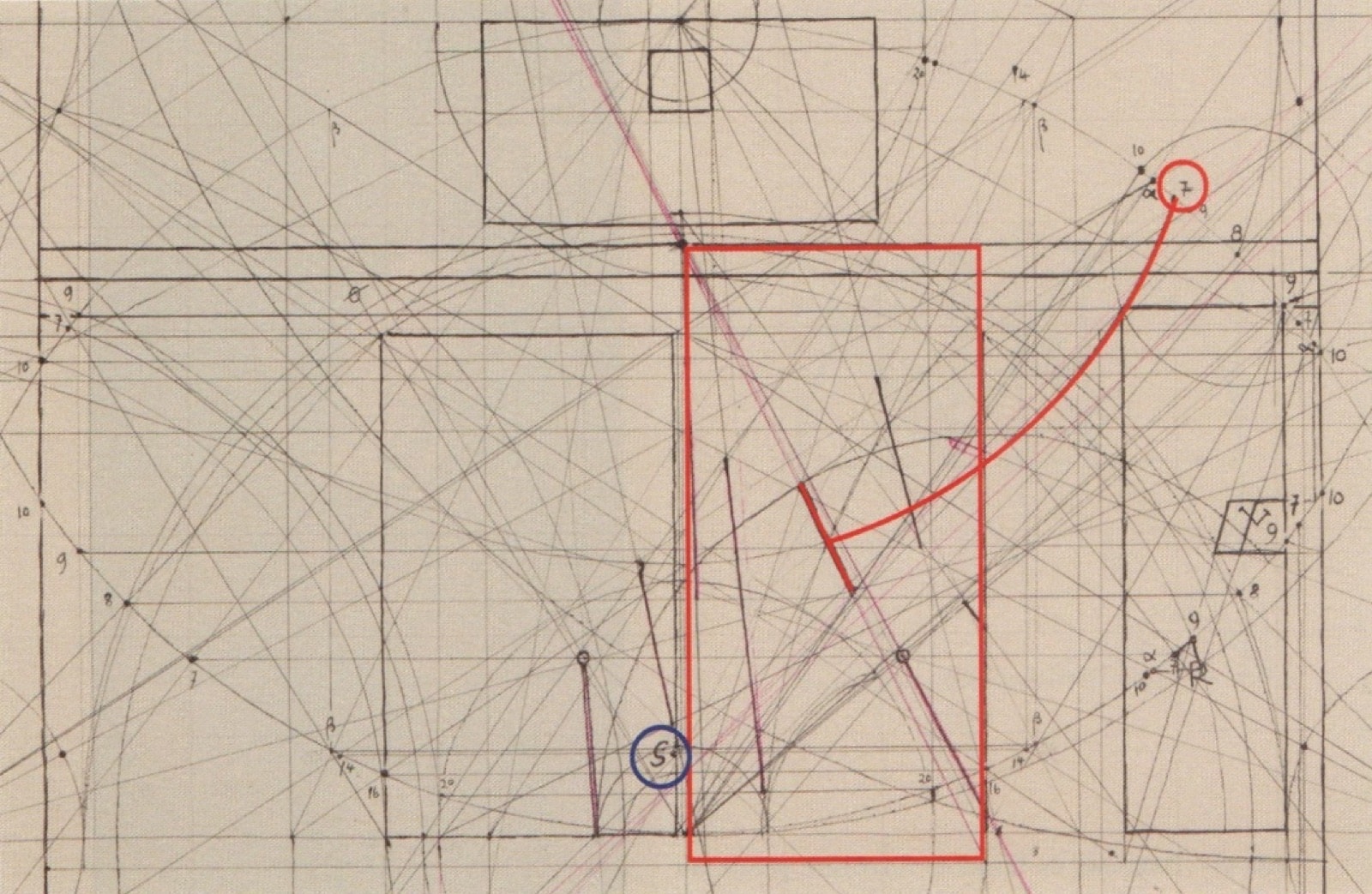
It will therefore be fitting to rename the central panels: that on the right (called the Prince’s), I propose, henceforth, be named that of Spiritual Authority, and that on the left (or the Archbishop’s) that of Temporal Power.