CONFIGURATION AND DESTINY OF THE POLYPTYCH
The six panels that compose the Polyptych depict 58 figures, representative of the Portuguese and Burgundian Courts and of the various strata of their respective fifteenth-century societies, gathered in a monumental and solemn assembly. They are arranged around a mysterious, twofold (2) figure, haloed, vested in a red dalmatic and bearing complementary attributes, manifested in both central panels.
The Polyptych obeys a rigorous symmetry, with thirty figures (17 + 13) on each side of the central vertical axis, distributed across three panels, one large and two smaller.
Likewise, the horizontal axis, which separates the principal group from the secondary one, divides in both triptychs the group of 30 figures into one of 13 and another of 17.
*
The Polyptych was painted in oil and tempera on 25 boards of Baltic oak, whose dendrochronological analysis of the last growth ring, carried out in 2002, revealed an interval of 48 years (1383-1431).
Dimensions and result of the dendrochronological analysis of the six panels of the Polyptych, from the observer's left to right:
Friars = 2.065 x 0.645 (top) and 0.639 (base) / 9.4 x 2.9 palms
3 boards (painting possible from 1442)
Fishermen = 2.067 x 0.598 (top) and 0.601 (base) / 9.4 x 5.6 palms
3 boards (painting possible from 1432)
Prince = 2.070 x 1.280 (top) and 0.1286 (base) / 9.4 x 5.8 palms
7 boards (painting possible from 1434)
Archbishop = 2.070 x 1.280 (top) and 0.1286 (base) / 9.4 x 5.8 palms
6 boards (painting possible from 1442)
Knights = 2.060 x 0.604 (top and base) / 9.4 x 2.7 palms
3 boards (painting possible from 1442)
Relic = 2.065 x 0.631 (top and base) / 9.4 x 2.9 palms
3 boards (painting possible from 1435)
The following are the minimum dates required for the commencement of painting on each of the six panels (after the felling of the tree and its respective drying for a minimum period of exactly three years):
1442 (Friars), 1432 (Fishermen), 1434 (Prince),
1442 (Archbishop), 1442 (Knights), 1435 (Relic)
It is concluded that the work could not have been begun before 1442 (the minimum date), at least for three of the panels (Fishermen, Archbishop and Knights), without prejudice, however, to its possibly having been executed at a later date. Such dating, and other reasons presented in due course, belie those who, based on the study (by Professor Peter Klein of the University of Hamburg), as well as on the deciphering of the marks inscribed on the boot of the Child in the Prince panel, where they discern the painter's signature and the date of the painting's completion, postulate that the Polyptych dates from the year 1445.
Some panels underwent reductions in dimension, in height or width, likewise confirmed by the expert examination to which they were subjected:
“[…] traces were found of cuts made with a saw or plane on the left side of the panels of the Friars, the Prince and the Archbishop, and on the right side of the Relic panel, as well as on the upper edge of all the panels. However, the existence of unpainted borders is also recorded in those areas, proving that such cuts cannot have caused any significant reduction of the supports and did not significantly affect the integrity of the painted surface” (I. Vandevivere and J. A. Seabra de Carvalho, in Nuno Gonçalves – novos documentos, 1994).
The Polyptych (six panels) is complete, and possible additions of supposedly lost panels are not admissible.
The present arrangement of the Polyptych is, likewise, the correct one, for two orders of reasons:
1. the symmetry of the widths of the panels, identical two by two;
2. the alignment of the grid of the pavement, whose inclination increases gradually and without breaks in continuity, from the centre to the periphery, from the vertical to the proximity of the limit possible in terms of perspective.
Indeed, with the 6 panels arranged as the lines suggest, the following progressive variation of the angle of inclination is obtained, measured at the lower edge of each of them:
Central (Prince and Archbishop) 0 to 30 degrees
Intermediate (Fishermen and Knights) 30 to 45 degrees
Outer (Friars and Relic) more than 50 degrees
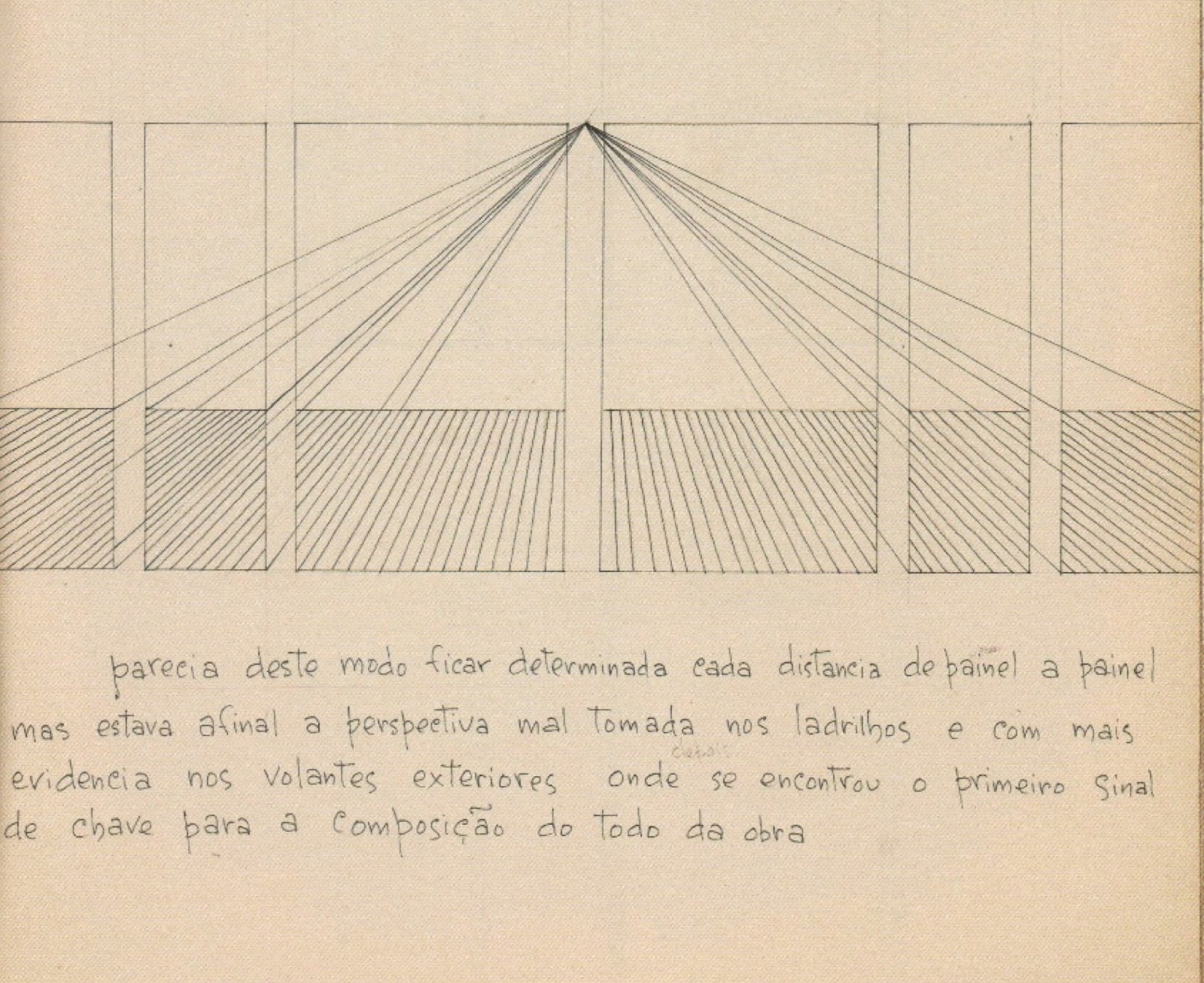
Calculation of the perspectives of the Polyptych, according to Almada Negreiros