A BRIEF CHRONOLOGY OF THE ALTARPIECE OF SAINT VINCENT AND OF THE POLYPTYCH
Comprising the Martyrdoms: a series of pictures on the Life, Martyrdoms and Miracles of Saint Vincent + 4 Saints (Saint Theotonius; Saint Francis; Saint Paul and Saint Peter).
The dendrochronological analyses carried out on the boards of the two surviving series suggest that all were painted during the second half of the fifteenth century: Saints (1415-1454); Martyrdoms (1436-1454).
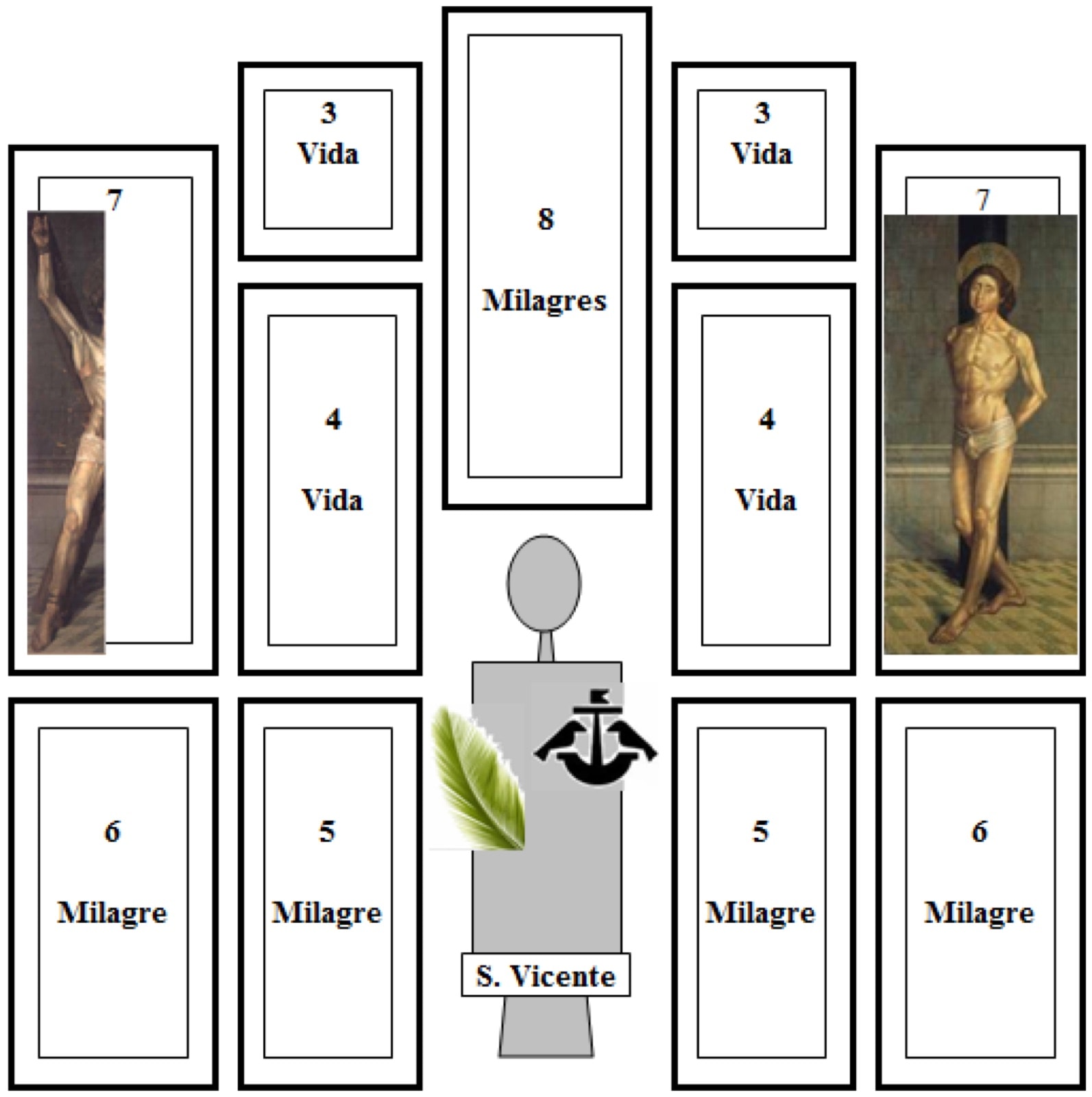
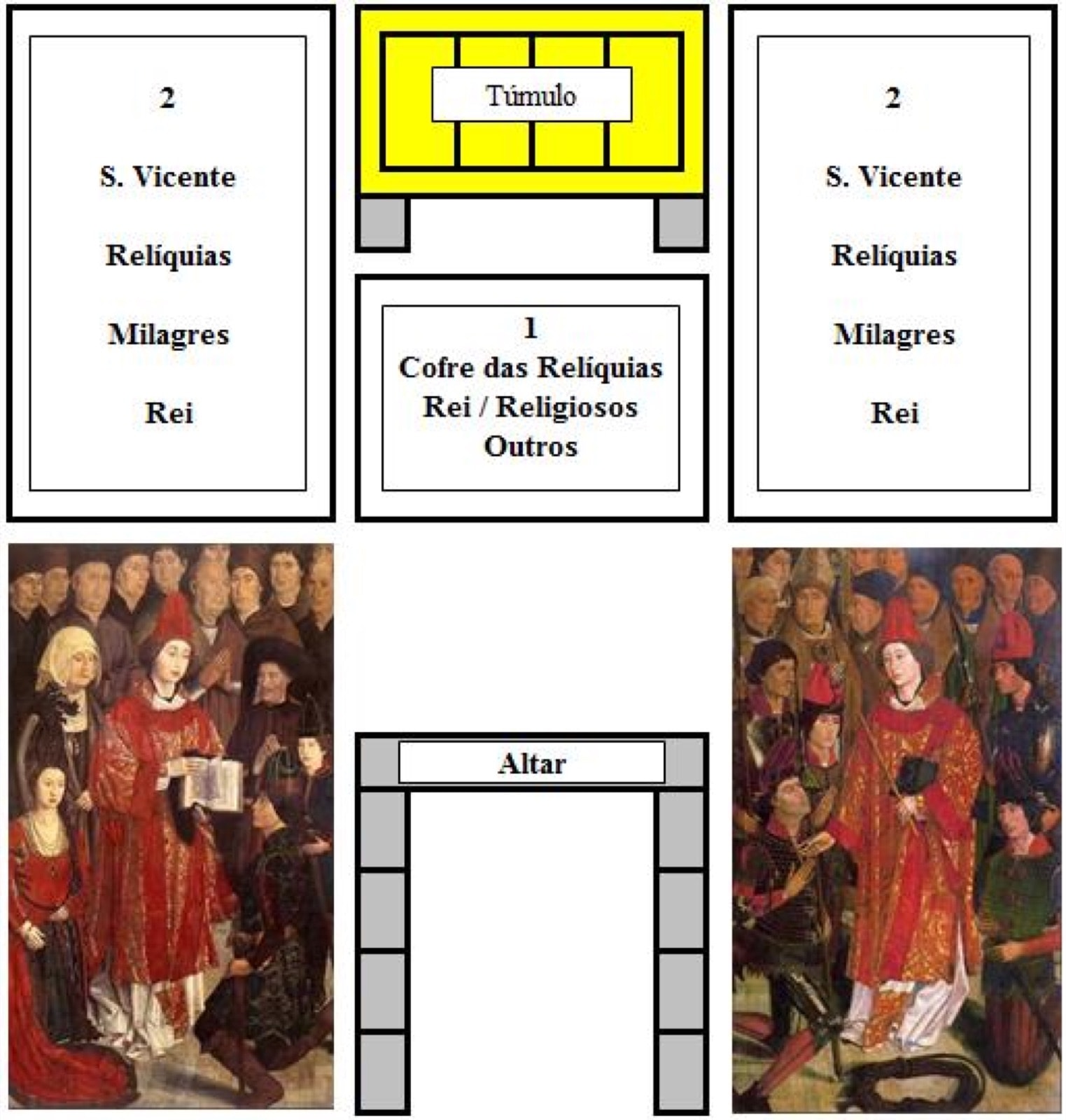
Conjectural reconstruction of the Altarpiece of Saint Vincent incorporating part of the Polyptych
In the Cathedral
• 1462: the earliest known record relating to the works on a new Altarpiece of Saint Vincent.
• 1467: a Visitation report notes that major works are under way on the Altarpiece of Saint Vincent.
• 1469: a letter of acquittance records that King Afonso V granted to the chapter of Lisbon Cathedral an endowment intended for the Altarpiece of Saint Vincent that was being constructed there.
• 1473: completion of the Altarpiece of Saint Vincent.
• 1531-1570: a period of 39 years during which the Altarpiece of Saint Vincent was accompanied by some panels of the Polyptych: the panels of the Knights and of the Friars were located on the Gospel side, from which it may be inferred that the other two were situated on the Epistle side, beside the altar of the patron saint of Lisbon.
• 1548: Francisco de Holanda places the “painter who painted it” in his roll of “Eagles” and, in recording the name of Nuno Gonçalves elsewhere in Da Pintura Antiga, unwittingly creates the phantasmal “fifteenth-century Portuguese school”, whose enigma has persisted to the present day.
• 1570: the boards of the Polyptych disappear, doubtless as a consequence of the decrees of the Council of Trent.
• 1642: the then Archbishop of Lisbon, D. Rodrigo da Cunha, provides the most detailed description known of the Altarpiece of Saint Vincent (História Eclesiástica da Igreja de Lisboa): “[…] Here, in this space, rises the altar of the saint, from which then springs the altarpiece with his image in full relief at the centre, holding the martyr's palm in his right hand, and in his left the ship in which he was brought to us. There follow, across the further panels of the altarpiece, in singular painting, various miracles of the saint, together with the principal episodes of his life and martyrdom […]”. He stresses that he had this ensemble renovated and gilded, on account of the devotion he held for the saint. He further mentions a set of sixteen panels that existed above the canons' choir stalls, relating to miracles of Saint Vincent, each bearing a Latin distich. He omits any reference to the Polyptych, absent from the site since 1570.
• 1690-1742: the taking down and storage of more than a dozen panels of the Altarpiece of Saint Vincent, painted by the same artist. There they remained until they were cleaned and dispatched to the Palácio da Mitra (Marvila) at the initiative of the Cardinal Patriarch D. Tomás de Almeida, in the year 1742, which preserved them from destruction in the earthquake of 1755.
Outside the Cathedral
• 1742-1821: the panels of the Altarpiece are recorded in two inventories of the Mitra (1754 and 1821) and in the so-called querela dos Agostinhos (the Augustinians' dispute) (1763-1768). From the documents relating this dispute, a body of data may be inferred concerning the more than a dozen panels depicting Saint Vincent that existed there.
The description of the fourteen panels recorded in the Inventory of 1821 (450 years after their creation) confirms that the said panels are the same ones taken down from the Cathedral in November 1690:
“A panel five spans wide and more than eight high, painted on board and representing the Coffer of the Relics of the said Saint, attended by a King and various religious and other persons, with a gilded Frame. [placed in the 2nd room of the Noble Floor of the Marvila Palace]”
“Two panels of almost eight spans wide and eleven high, with Walnut Frames, relating to Saint Vincent the Martyr and further relics and miracles, with a King giving thanks to him.”
“Furniture found in the said Quinta de Marvila – First Room – Two Panels four spans Wide and eight High, gilded frames, with the painting on Board of the Life of Saint Vincent […]
Noble Floor and First Room – Two panels eight spans and more high and four Wide, with gilded Frames, on Board of the Life of Saint Vincent.
[2nd room] Two Panels four spans wide and more than eight High, painted on board, dealing with Miracles of the Saint above.
Sixth Room, which is the Chamber – Two Panels five spans wide and eight High, gilded frames, painted on board, of a Miracle of Saint Vincent the Martyr.
Fifth Room – Two Panels of almost Five spans wide and eleven High, gilded frames, painting on board, dealing with the miracles of Saint Vincent the Martyr.
A Panel somewhat smaller, of the same Painting on Board, of Miracles of the same Saint.”
It is found that neither the description nor the dimensions recorded are compatible with the Polyptych, from which it is deduced that it was never at Marvila.
• 1821-1916: the whereabouts of this series of pictures is unknown.
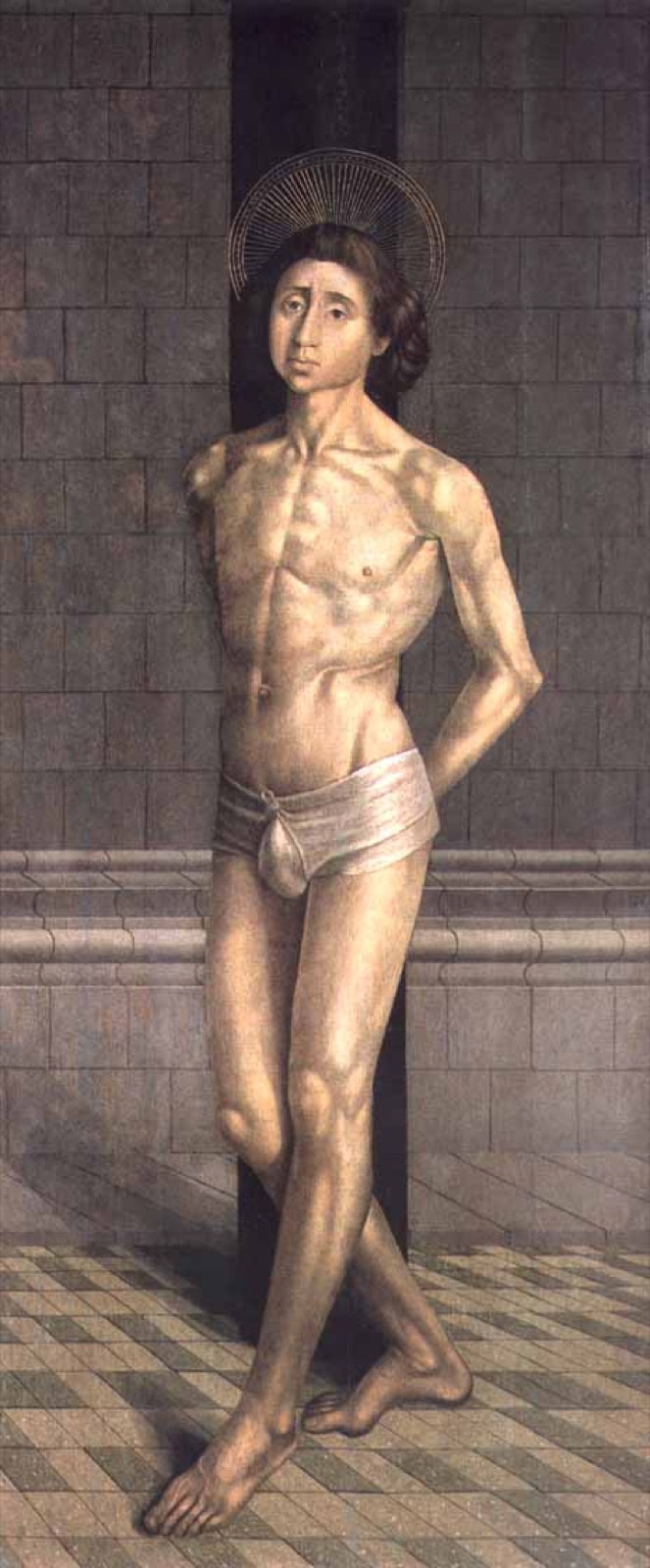
• 1916: the board Saint Vincent Bound to the Column, the only complete panel surviving from the Altarpiece, is incorporated into the National Museum of Ancient Art.
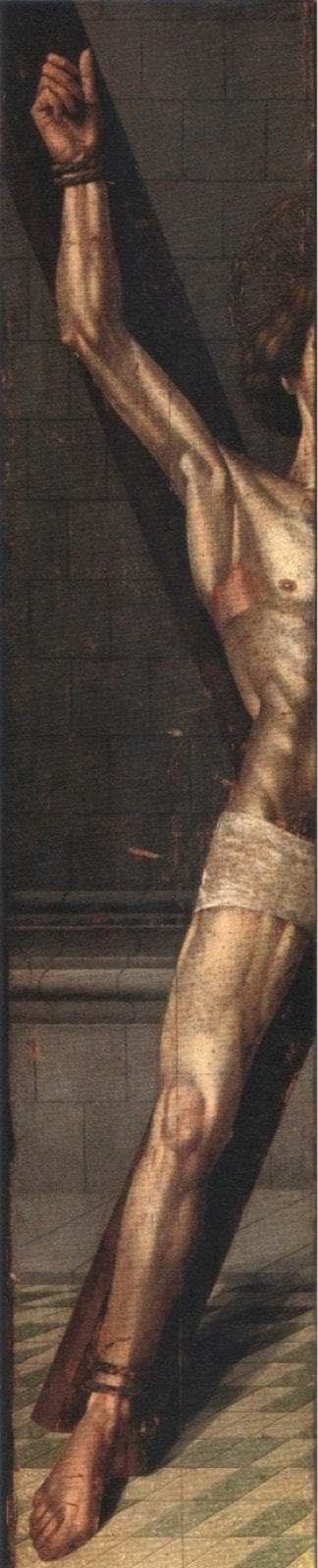
• 1935: the half-board Saint Vincent on the Saltire Cross, which is thought to have formed part of the Altarpiece, is incorporated into the National Museum of Ancient Art.
• 1950 (c.): a study asserts that the panels Saint Vincent Bound to the Column and Saint Vincent on the Saltire Cross (1462-1467) formed part of the Altarpiece.
• 2001: the results of the dendrochronological analyses conducted by the dendrochronology specialist Peter Klein, of the University of Hamburg, carried out on the six and a half boards of the Martyrdoms (the panels that remain from the Altarpiece of Saint Vincent), make it possible to conclude that in the assembly of these surfaces batches of wood different from those of the Polyptych were used, which would not have been the case had they been prepared for the same pictorial work. It is found that, in the group of the Saints, the dating of the last growth ring of the wood falls between 1415 and 1454 (39 years), whereas in the group of the Martyrdoms (Altarpiece) it corresponds to only 18 years (1436-1454). It is further concluded that the earliest date of the planks constituting the boards of the Martyrdoms (1436) is later than the most recent date established for the planks of the Polyptych (1431), which proves that the boards forming the support of both ensembles are of distinct origin, which would not have been the case if, as had been supposed, they had been assembled concurrently.
• 2010: an extract is published from an Inventory drawn up in 1821 of the goods existing in the palace of Marvila, in which fourteen panels depicting Saint Vincent are cited, together with their dimensions, expressed in spans, and also the colours of the respective frames:
a. Seven relate to miracles and four to the life of the saint. Their dimensions range between “four spans wide by eight high” and “almost five spans wide by nine high”, that is, an interval between 88 x 176 cm and 103 x 198 cm. The frames were gilded.
b. Another panel is described as “representing the coffer of the Relics of the said Saint, attended by a King and various religious and other persons”. The dimensions are: “five spans wide and more than eight high”, which corresponds to 110 x 183 cm. Gilded frames.
c. The two remaining ones are “relating to Saint Vincent the Martyr and further Relics and Miracles, with a King giving thanks to him”. The measurements provided are: “almost eight spans wide and eleven high”, which is equivalent to 169 x 242 cm. Walnut frames.
In the same year Pedro Flor published the same documents, supplemented by the references to the four boards of the Saints, which also formed part of the said Inventory, accompanied by their respective dimensions, likewise expressed in spans (except one, in varas):
“1. A panel one vara wide and one vara and a half high [110 x 165 cm], gilded frame, painting on board, of a prelate presenting, in alb, mitre and crozier […].
2. A panel of more than five spans wide and six high [110 x 132 cm], with gilded frame and painting of Saint Francis with the crucifix in his hand […].
3. Two panels five spans wide and eight high [110 x 176 cm], with black frame and gilded fillets, one with a painting of Saint Peter and the other of Saint Paul, very old […]”.
It is found that, in the meantime, these boards have also suffered cutting, which is confirmed by the discontinuities in the benches on which the saints are seated, given that their present measurements are 89 x 116 cm; 90 x 118 cm; 80 x 136 cm and 84 x 137 cm, respectively.

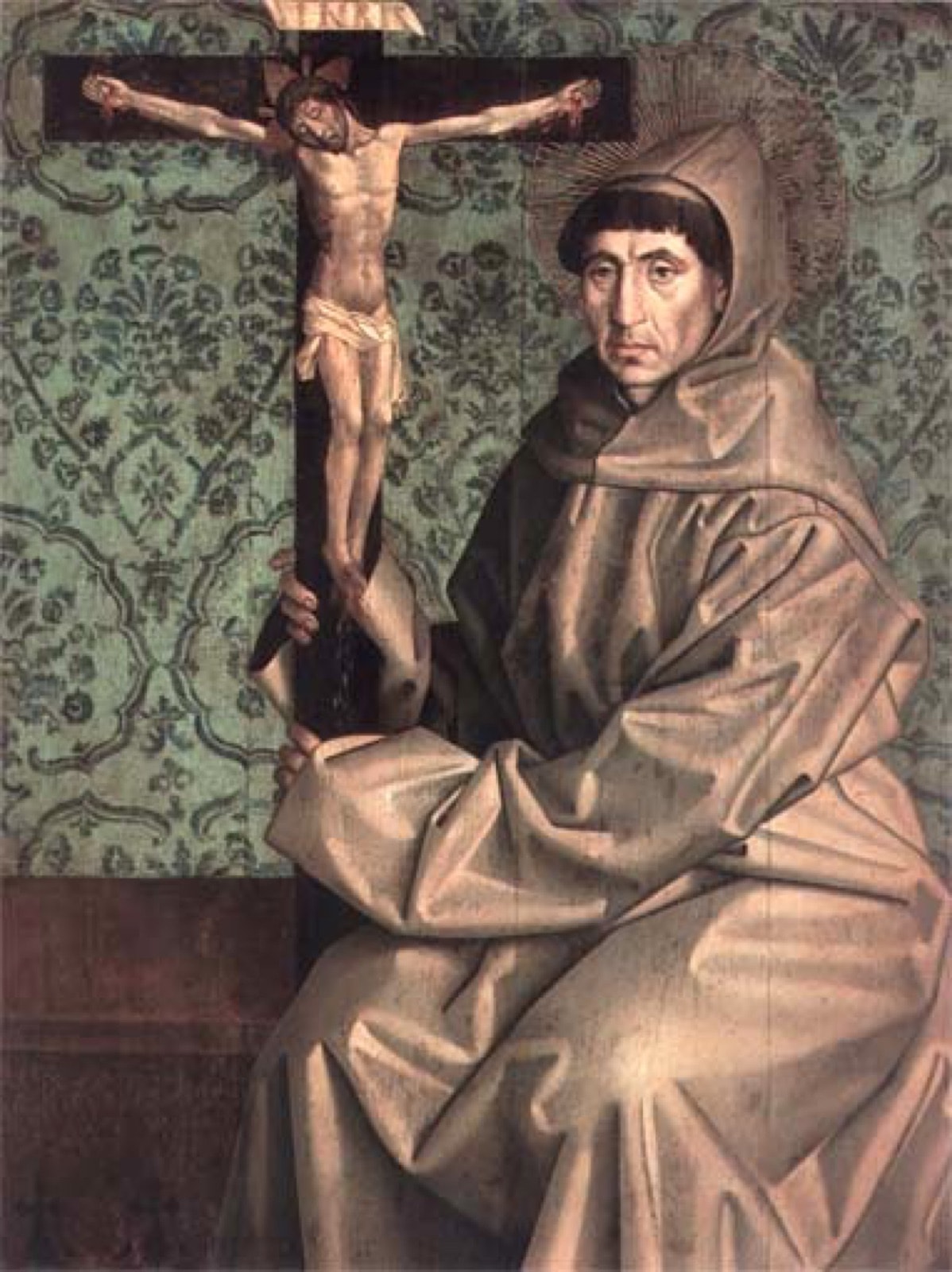
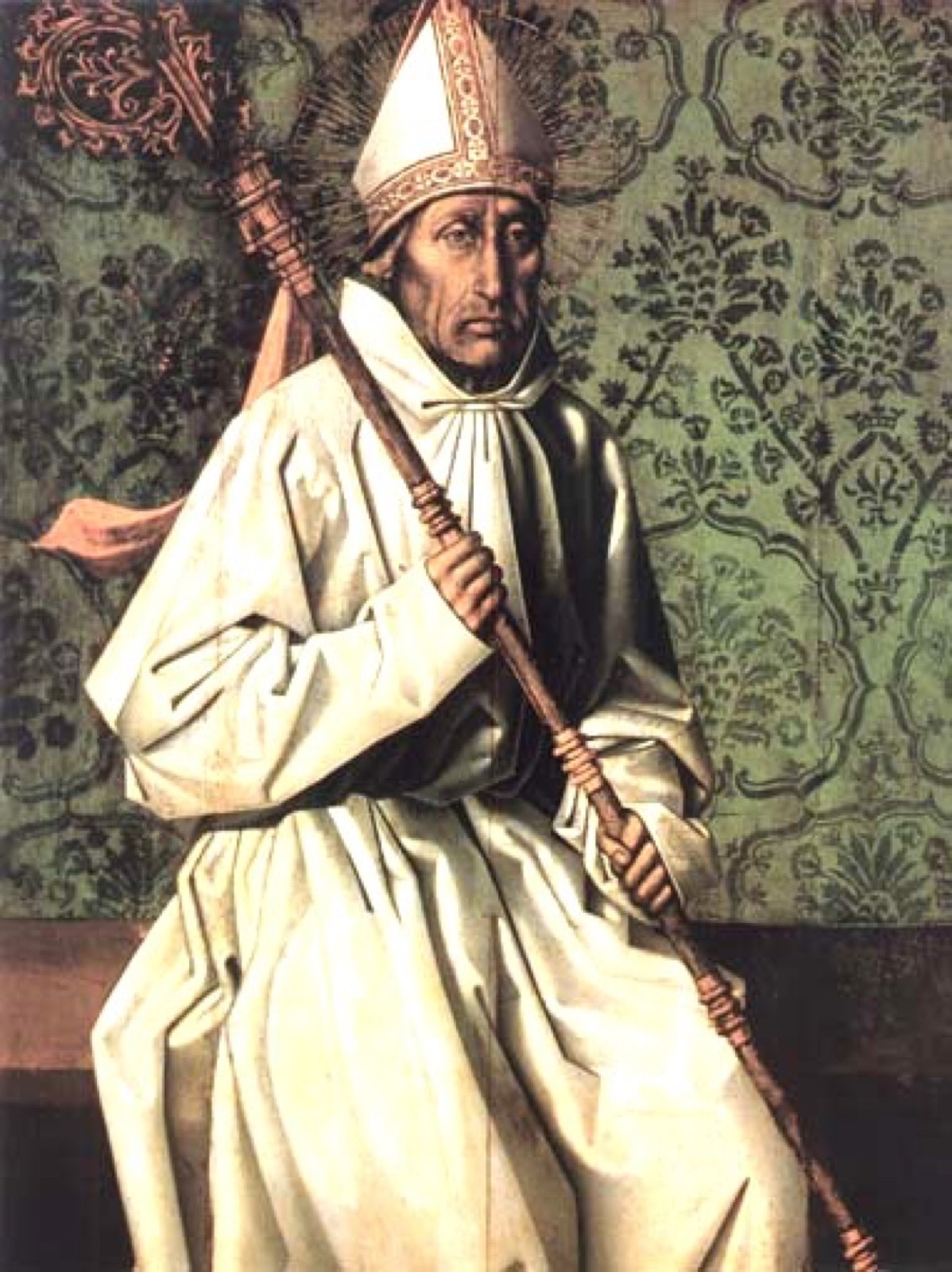
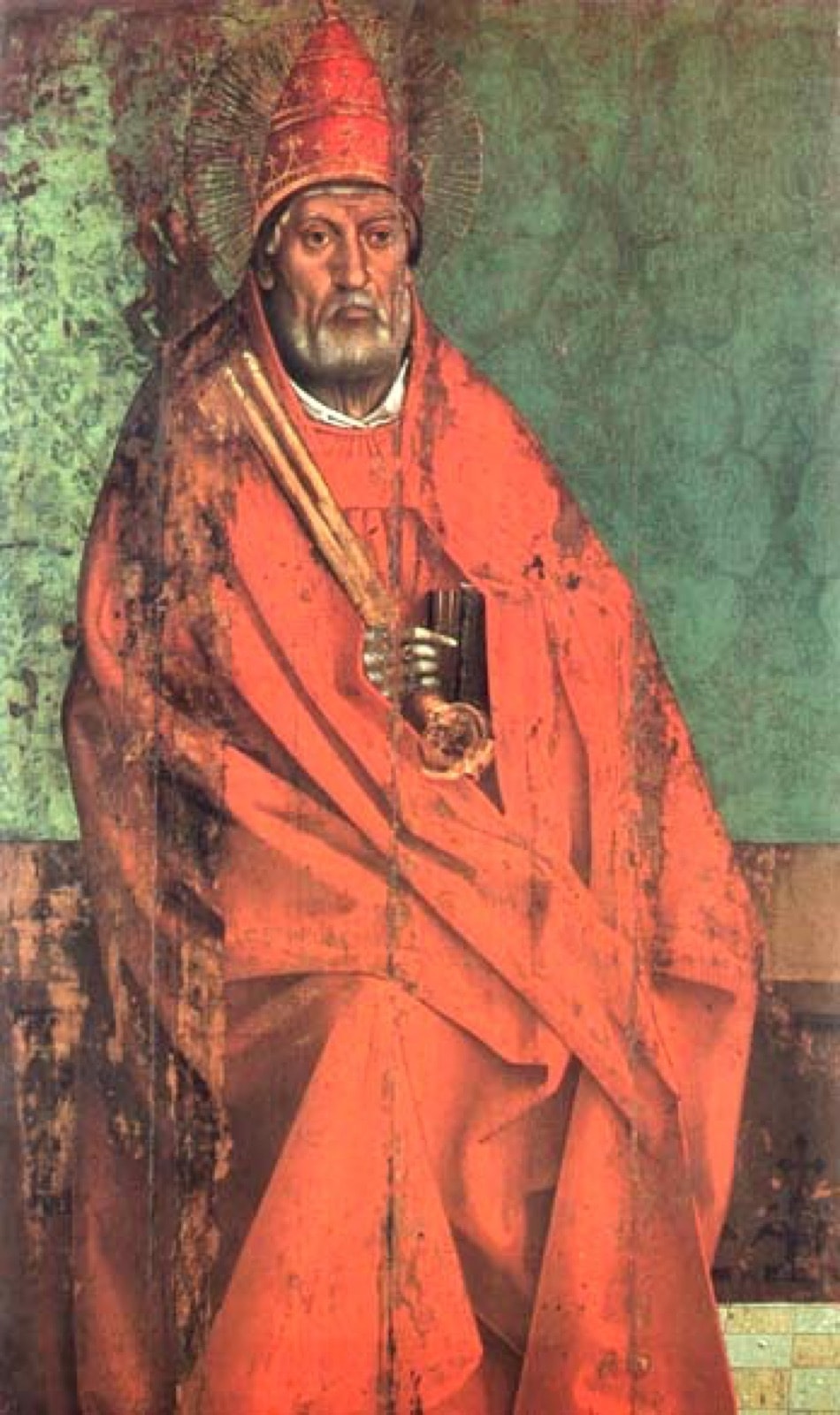
The measurements stated are either smaller than, or considerably larger than, the present dimensions of any of the boards of the Polyptych, which makes it possible to exclude it from the items of the Inventory.
Whence it is reasonable to conclude that the two ensembles – the Polyptych and the Martyrdoms – were restored at different times and by different restorers, which indicates that they were not together in the seventeenth century.
2025: of the eighteen panels (fourteen relating to the Altarpiece and four to the Saints) referenced in the Inventory of 1821, only two Martyrdoms survive (Saint Vincent Bound to the Column and Saint Vincent on the Saltire Cross) together with the four Saints: Saint Theotonius; Saint Francis; Saint Paul and Saint Peter [MNAA].