THE PAINTER
As early as 1910, and on the basis of the vague information provided by Francisco de Holanda, José de Figueiredo addressed the problem of the Polyptych's authorship. Weaknesses in his thesis were immediately pointed out.
The authorship of the panels was then attributed to the painter Nuno Gonçalves on the basis of the interpretation of a monogram detected on the boot of the kneeling figure in the Prince's Panel, revealed during a restoration of the painting in the 1930s, and which was held to coincide with other signatures used by the same artist in contemporary documents and works.
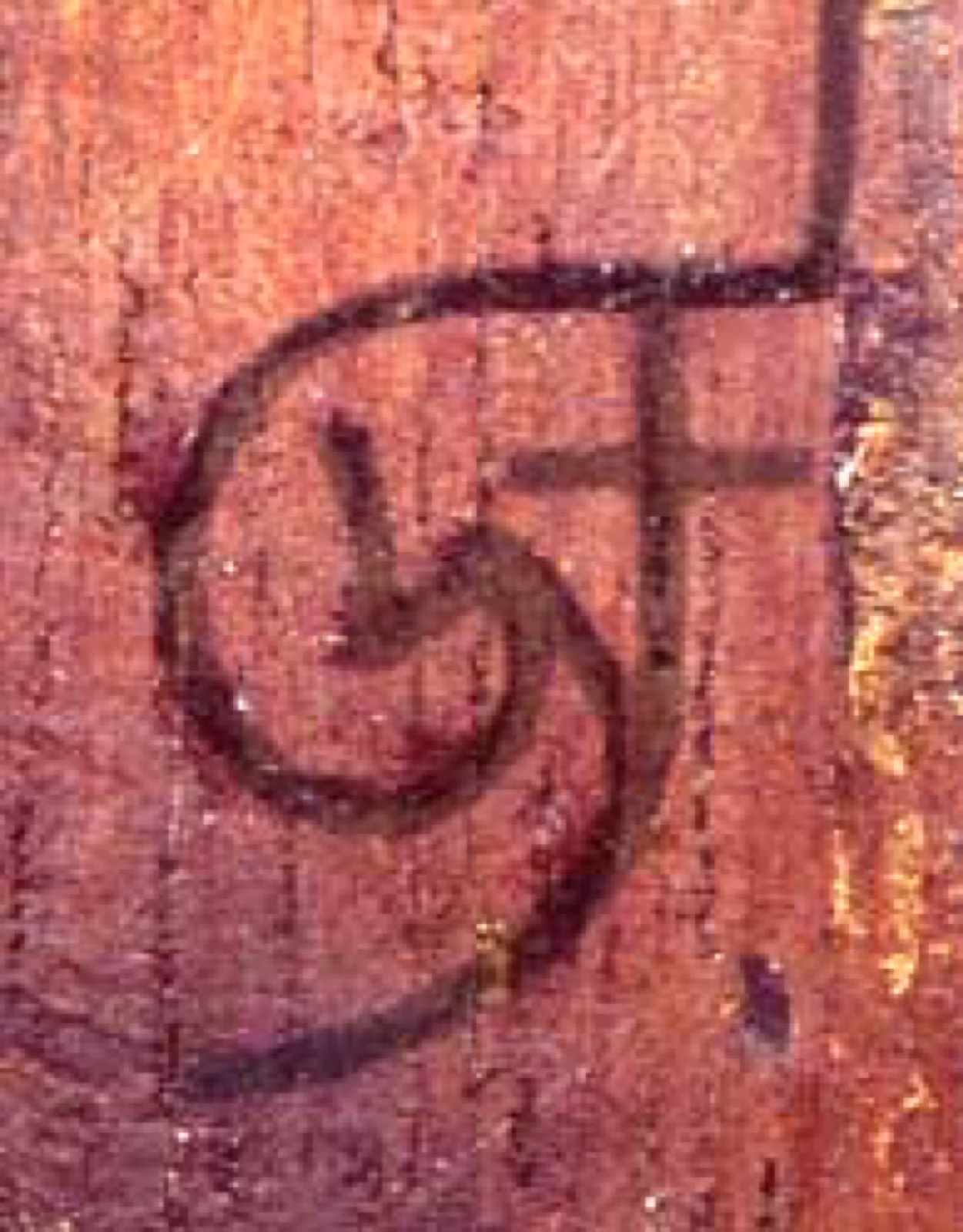
The supposed signature – or initials – interpreted as those of Nuno Gonçalves was to prove equally fragile and open to readings that were not always consensual, as was a presumed portrait of the painter that José de Figueiredo believed he had identified in the Prince's panel and which became fertile ground for all manner of speculation.
It was above all the contestation of Figueiredo's "Vincentine" thesis that led to the contestation of his "Gonçalvine" thesis, since the plausibility of Holanda's information came to be challenged by other iconographic readings.
Of the various known references to the Altarpiece of Saint Vincent in Lisbon Cathedral, the first to mention the name of Nuno Gonçalves (Francisco de Holanda, in 1548) neither identifies nor describes any panel of the Polyptych.
It has never been possible to define rigorously the corpus of works attributable to Nuno Gonçalves as royal painter to King Afonso V, and so it cannot be ruled out that the Polyptych may have been painted by another artist, perhaps a foreign one.
Indeed, the only account that mentions some of the panels in this group (the Rio manuscript) puts forward the name of another painter, the aforementioned Mota.
Since it bears neither an unequivocal signature nor a clear date, the Polyptych has remained shrouded in an aura of great mystery, common to several generations of scholars and academics, which neither the advances in documentary research nor the technical examinations undertaken in the late twentieth century and during the present century have managed to clarify satisfactorily.
Nuno Gonçalves's documented biography rests on a mere six diplomas.
It is known that, on 20 July 1450, Nuno Gonçalves was appointed royal painter by Afonso V, with an annual salary of 12,000 reais brancos. This status was reaffirmed by a second royal charter, of 6 April 1452, by which the stipulated salary was increased by 3,432 reais and, in addition, he was granted annually "a piece of Bristol cloth for his attire".
The precise indication of his standing as royal painter, and the fact that the second charter, issued in Évora, refers to an increase in salary, in money and in kind, may be understood as proof of the king's satisfaction with the "services" rendered.
In 1462, he acquired a property near the Convent of São Francisco (Lisbon).
Two further documents echo his activity, dated 18 March and 20 April 1463 respectively.
The first is a deed of emphyteusis of three derelict buildings on the part of Nuno Gonçalves. The second is a deed granting a plot of land to the same painter. Of note is the fact that the documents explicitly reinforce the artist's identity, as well as his standing as painter to King Afonso V.
It is further known that, on 25 August 1470, by a letter of acquittance in which, besides royal painter, his standing as a knight is indicated, he received as payment the sum of 18,130 reais relating to the (now lost) altarpiece that he painted for the Royal Chapel of the Palace of Sintra.
A year later (12 April 1471), a new commission for the painter was recorded in the Livro Vermelho de D. Afonso V, certainly one of great responsibility, since, replacing the painter João Eanes, he took over from him the painting works of the city of Lisbon.
These last two documents indicate, as Adriano de Gusmão aptly observed, the painter's growing prestige and the king's recognition of him – in the first, the social distinction conferred upon him by the dignity of knighthood, certainly also arising from a just reward for his artistic qualities and, in the second, the consequent expansion of his responsibilities.
It is not known when Nuno Gonçalves died; however, the year 1492 has been put forward as marking the end of his activity, on the basis of an indirect reference: a document dated 26 July, which mentions a "[...] plot of land in the city that belonged to nuno gonçalves painter", any other explicit indication being absent.
*
One of the grounds on which the alleged mastery of Nuno Gonçalves's work rests is of a technical nature, specifically the "process of preparing the panels", which became one of the most important means of verifying the autonomy and originality of fifteenth-century Portuguese painting.
After analysing the technical procedures adopted in different artistic centres, José de Figueiredo considered Nuno Gonçalves wholly original, since
"[…] his panels are carefully prepared on the obverse, the boards being, on that side, planed as completely as possible. And there, on that surface, as is done today, the painter, after applying a thin preparation of oily, brownish paint, into which neither chalk nor glue enters, draws the composition in pen, indicating every detail with great minuteness [...]".
The absence of a thick preparatory layer, but rather a thin preparation of oily paint, in the same author's view, constituted, then, a mark of difference and of originality. He himself states it
"[…] when we come to consider the existence of a school of Portuguese primitive painting, we shall see the conclusions to be drawn from this individuality of processes and its connection with those of certain subsequent Portuguese painters."
Still on this subject and on this basis, he asserted that the application of the paint "onto the wood, without the prior, more or less thick, preparation of chalk", links the painting of the Galicia region to the Portuguese, namely a painting from the convent of Belvís, in Santiago de Compostela, whose process he considers close to that which he had observed in the Saint Vincent panels, in those of Grão Vasco and in a Saint Anthony in the sacristy of Santa Cruz de Coimbra.
However, the conclusion of the report on the microscopic analyses carried out in 2013 on the constituent materials of the ground layers applied to the 12 boards credited to the "workshop" of Nuno Gonçalves (6 Panels of the Polyptych, 2 Martyrdoms and 4 Saints) reached results that contradict the official thesis, still indebted to that of José de Figueiredo:
"[…] it was found that there are differences in composition in the preparatory layer between the Polyptych of Saint Vincent – the Panels – and the paintings of the other two groups, which suggest that a different batch of "gesso" was used in the former", which proves that the Panels were executed at a different time from the other two groups. […].
The possibility that the proportion between these two compounds varies according to the production batches is of considerable interest for the comparative study of the three groups attributed to Nuno Gonçalves, since µ-XRD and µ-FTIR detected characteristics in the preparations that distinguish the Polyptych of Saint Vincent from the remaining works. By µ-XRD, a proportion of gypsum far lower than that of anhydrite was systematically found in all the paintings of the Polyptych, significantly different from what was observed in the other two groups. On the other hand, in the µ-FTIR spectra of the samples from the Polyptych of Saint Vincent a specific band was detected at 984-985 cm⁻¹, normally attributed to barium sulphate, a band which was not observed in the spectra relating to the other paintings. However, by SEM-EDS, no barium was detected in the preparations, which means that the band in question should not correspond to barium sulphate, but rather to another compound which, however, it was not possible to identify. In any case, this band and the differing proportion between anhydrite and gypsum constitute distinctive characteristics that suggest that the batch of "gesso" used for the Polyptych was a different one".