MELCHIZEDEK
The most mysterious of all the figures of Holy Scripture, mentioned only three times in the canonical Bible.
A paradigm of the Messiah, he is the exclusive dispenser of authentic spiritual initiation, in keeping with the teaching of Psalm CIX: “Thou art a priest for ever after the order of Melchizedek”.
The Old Testament episode that best prefigures the institution of the Eucharist is the one that occurs when the "father of all believers", Abram, after having routed the kings of Mesopotamia and on returning to his own lands, was visited by Melchizedek, who offered him an oblation of bread and wine, as related in Genesis, XIV, 17-20:
"When Abram returned victorious over Chedorlaomer and the kings allied with him, the king of Sodom went out to meet him in the valley of Shaveh, that is, the King's Valley. And Melchizedek, king of Salem, brought forth bread and wine, for he was a priest of the Most High God, and he blessed Abram, saying: 'Blessed be Abram by the Most High God who created heaven and earth! Blessed be the Most High God who delivered thine enemies into thy hands!'. And Abram gave him a tithe of everything."
It was to Saint Paul, in the Epistle to the Hebrews, VII, 1-3, that we owe the establishment of the direct correlation between the meeting of Abram and Melchizedek and the New Covenant instituted by Jesus Christ, underscoring the superiority of the Redeemer over the Levitical priests:
"[...] this Melchizedek, king of Salem, priest of the Most High God, who met Abraham as he returned from the slaughter of the kings and blessed him, to whom Abraham gave a tithe of all things, whose name means first king of righteousness and then king of Salem, that is, king of peace, without father, without mother, without genealogy, having neither beginning of days nor end of life, but made like unto the Son of God, abideth a priest for ever."
Further on, he justifies the complete revocation of the Mosaic Law and its replacement by that of the Gospel of the Son (4-19):
"Consider, then, how great this man was, unto whom even Abraham the Patriarch gave a tithe of the spoils. Now the sons of Levi, called to the priesthood, must, according to the Law, levy the tithe upon the people, that is, upon their brethren, even though these are descendants of Abraham. But he, not being of their lineage, received the tithes of Abraham and blessed the holder of the promises. Now, without any contradiction, it is the lesser who is blessed by the greater. And here it is mortal men who receive the tithes; but there it is one of whom it is testified that he liveth and, so to speak, through Abraham [...]. Now, if perfection had come by the Levitical priesthood – for it was under it that the people received the Law – what further need would there be for another priesthood to arise after the manner of Melchizedek, and not be called 'after the manner of Aaron'? Indeed, the priesthood being changed, there is necessarily wrought a change of Law also. Now, He of whom these things are said belongs to another tribe, of which no one ever served at the altar. For it is well known that Our Lord sprang out of Judah, a tribe of which Moses said nothing at all when speaking of priests.
And this is yet much clearer if, after the likeness of Melchizedek, there ariseth another priest who is not appointed according to a rule of carnal precept, but according to a power of an indissoluble life. For there is this testimony: Thou art a priest for ever, after the manner of Melchizedek. On the one hand, therefore, the former carnal precept was annulled because of its weakness and uselessness, for the Law brought nothing to perfection; on the other hand, a new and more perfect hope was introduced, by which we draw near unto God."
As a general rule, iconography depicted the moment in which Abram received, as an authentic investiture, the blessing or communication of a spiritual influence (the bread and the chalice offered by Melchizedek), with one knee on the ground, in the manner of mediaeval royal figures.
Melchizedek, in turn, prototype of the Messiah, is usually presented as summus sacerdos, in keeping with the epithets of "King of Justice" and "King of Peace", wearing attire that combines Christian vestments (the dalmatic) with orientalising priestly garments (the hood and the floor-length tunic), as well as a royal insignia (the crown encircling his cowl).
The relevance of the theme was notable in Portugal, perhaps by virtue of the fame of Prester John, the Christian prince of the far reaches of Asia, who must not be confused with the negus of Abyssinia, himself likewise at once Emperor and Pontiff, in whose Kingdom the Dry Tree was said to exist, which had grown from a shoot of the Tree of Knowledge, that is, of the Central Tree of the Earthly Paradise.
In the sixteenth century, interest in the theme remained alive among Franciscans and the professed members of the Order of Christ, as may be inferred from the panels depicting the scene of the Meeting of Abram and Melchizedek originating from churches under their jurisdiction. At St John the Baptist of Tomar is kept the one among these panels that unequivocally synthesises the ultimate meaning of the mission with which Portugal, the Ensign of the Faith in the view of the discerning Gil Vicente, found itself invested for having protected the Order of the Temple, which, in its original form, had been rendered unable to honour the commitment undertaken at the time of its constitution:
1) To labour to offer new worlds to the World, encouraging contact among its diverse peoples so that, by fostering racial miscegenation, the vital substance in each being might come to constitute the support of a renewed biotype of humanity;
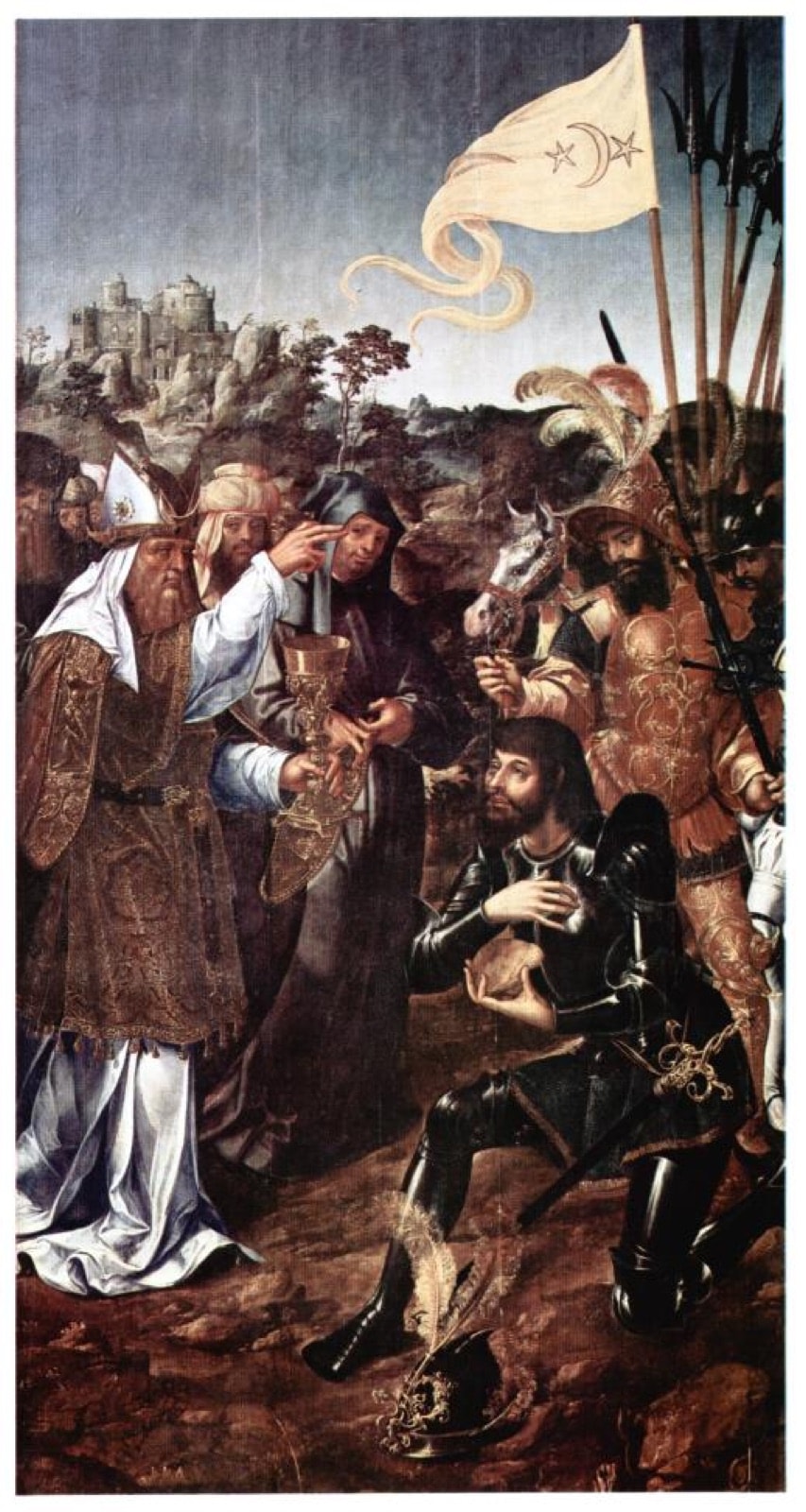
Meeting of Abram and Melchizedek
Panel by Gregório Lopes, belonging to the dismantled altarpiece of the chancel of the church
of St John the Baptist of Tomar. In the background, half-hidden by the enigmatic
Melchizedek, King of Salem and Priest of the Most High, may be glimpsed the figures embodying the three great confessions of the Book: a Jew, a Christian and a Muslim. Thus proclaimed, the ecumenical mission that the Order of Christ inherited from the Temple becomes indisputable.
2) To undertake the unification of all creeds into a religion without creeds, which would bear the name of Fifth Empire.
In the Polyptych, Melchizedek, wearing a dalmatic, presents himself under both facets of Priest (right of the painting, left of the observer) and King (left of the painting, right of the observer), presiding over an assembly of Portuguese and Burgundians who take part in a Mass of Pentecost, of which He is the celebrant, in expectation of the advent of the New Covenant to be instituted by the Paraclete (Holy Spirit), before the consummation of the Ages.
The mysteric character of the event is manifest, one which successive generations of art historians and scholars never managed to explain convincingly, ever preoccupied with banal, literally historical and chronological identifications.
Such an event is marked by the epiphany of the Comforter Himself, who becomes visible, descending in the flesh (as, before him, Christ did), and reducing the mitred Archbishop (of severe and authoritarian countenance) and the other Catholic clergy of his Chapter, confined to the side of Temporal Power (!), to no function other than that of mere passive spectators, the Age of the Son having run its course.
There are 11 figures in the background of each of the central panels, making a total of 22 (i.e., as many as the letters of the Hebrew alphabet and the ways to the Absolute).
Before them, the Envoy of God (He who is to come and who has existed from all eternity), that is, the 515, the “Saint” attended by 5 figures (symmetrically arranged: 3-1-2, on the right; 2-1-3, on the left), conceals the principal action from nearly all those gathered there, as though what they celebrate and the Messenger Himself were destined to be observed only by the spectators external to the scene and by those who, effectively partaking in it, were possessed of an inner and timeless vision, capable of accessing the mundus imaginalis, from which the New Jerusalem will arise, miraculously.