THE FALSE PRINCE HENRY, IN FACT, D. DUARTE
Who is the figure with moustache and Burgundian hat in the so-called panel of the Prince? It will not be Prince Henry the Navigator (Infante D. Henrique), as the official thesis maintains, along with many others, based on an illumination accompanying a manuscript of Azurara’s Chronicle of Guinea, found in the nineteenth century in the National Library of Paris.
Everything suggests that it was placed there a posteriori (after the motto of the accompanying device had been altered) and inspired by the Polyptych, and not the reverse.
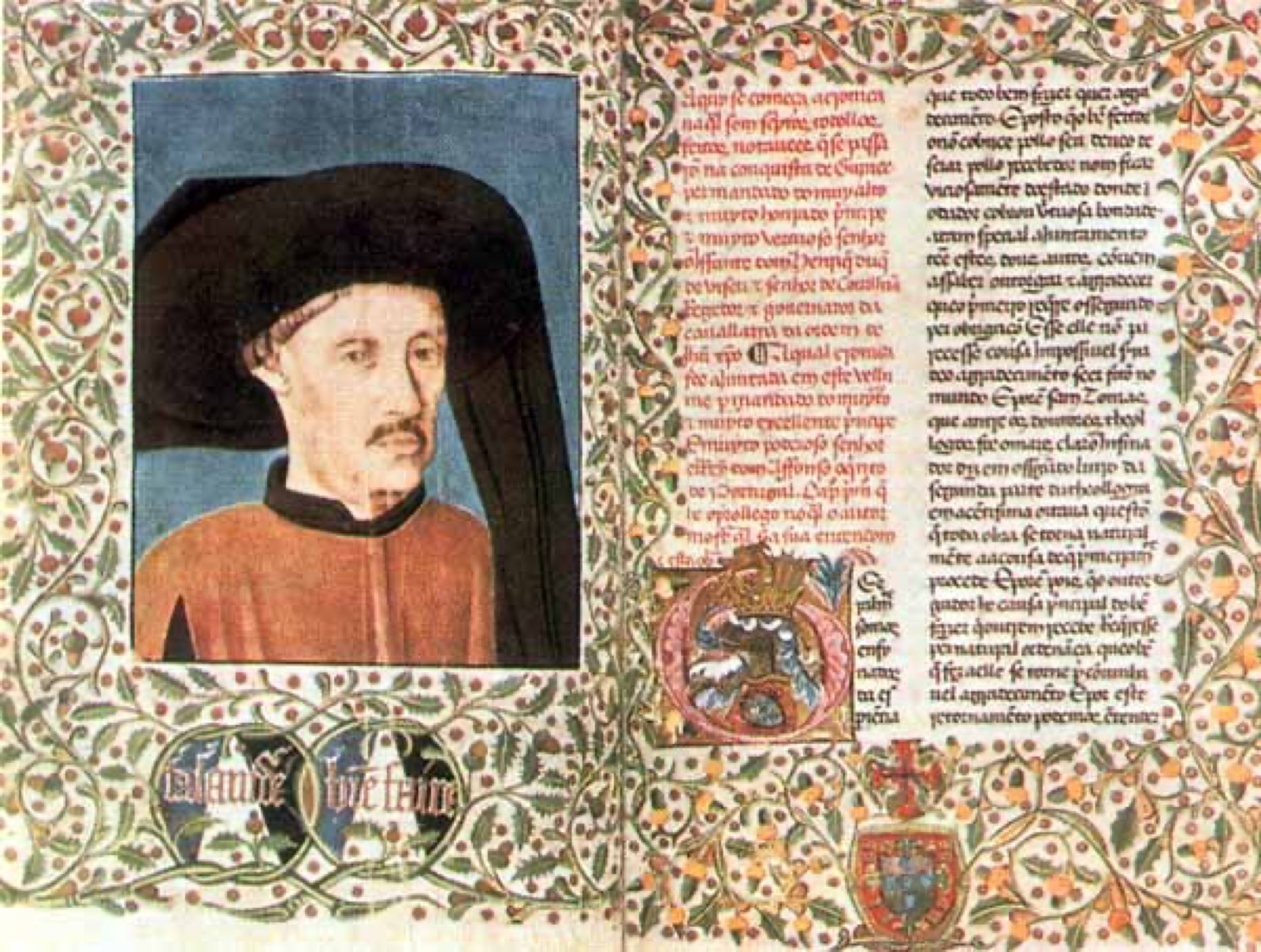
Concerning the device of the illumination, talant de biẽ faire, Belard da Fonseca
demonstrated that its spelling does not accord with that used in the period, nor with that observed on the Prince’s tomb in the monastery of Batalha:
talant de bien fere.
Be that as it may, in 1960 Ernesto Soares, Luís Reis Santos, António Belard da Fonseca, among other researchers and iconographers, demonstrated that the physiognomy of the illumination contradicted the evidence furnished both by the written sources and by the iconographic ones.
Belard da Fonseca examined and studied the document, in loco, in the National Library of Paris, which allowed him to analyse in greater detail the letters and words of that motto and to detect the following anomalies:
The first “a” of “talant” differs in its tracing from the other two “aa” of the legend: the second of that word and the one in “faire”.
The “e” of this last word slightly overlaps the vegetal circle and differs a little from the “ee” of “de” and of “biẽ”.
Looking at the frame of the portrait through the transparency of the leaf, one discovers other strokes beside the “e” and on the lower part of the “i” of “biẽ”, which direct examination, not carried out in this way, does not reveal.
And above the “i” of “faire”, one sees a golden stroke that extends obliquely as far as the interlaced branch […].
Why does the device appear forced with difficulty within the two vegetal circles of that border, in such a way that, in order to fit “talant de”, no space was left between the two words and the very “e” of the particle had to be doubled, the same happening with “biẽ”, which, in order to fit, was joined to “faire” and had to be abbreviated with a tilde over the final “e”?
In all likelihood it will be not Prince Henry the Navigator, but his brother King Duarte.