D. JOANA DE TRASTÁMARA, THE EXCELLENT LADY
(1462-1530)
The Lady who faces King Afonso V has been identified as D. Isabel, first wife of the African.
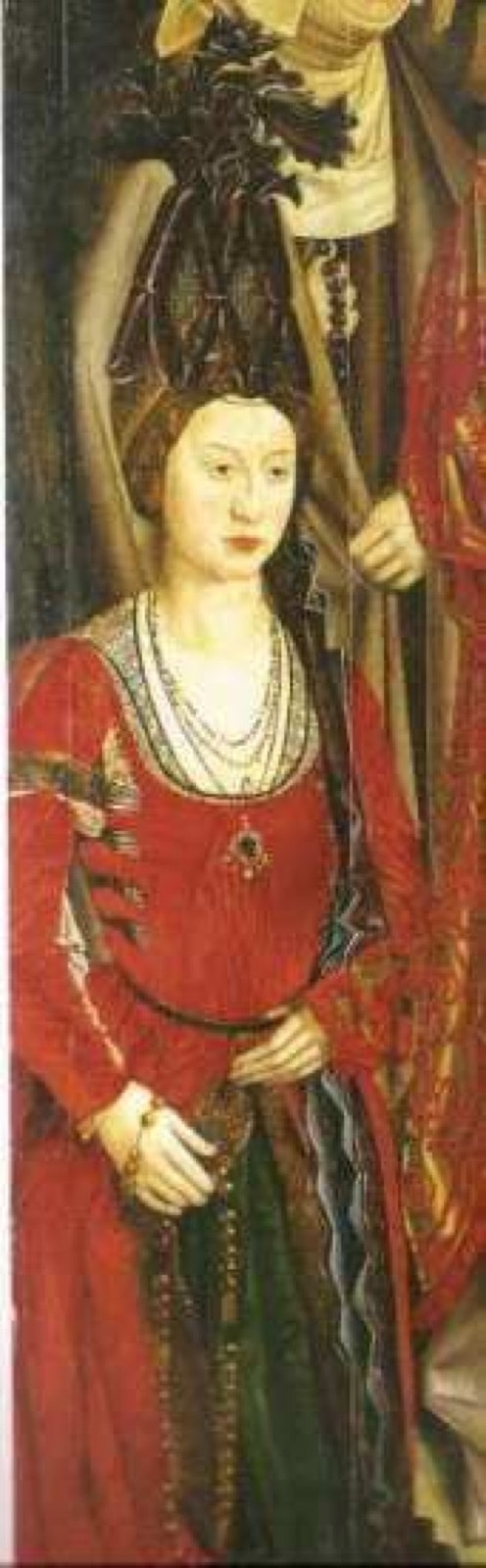
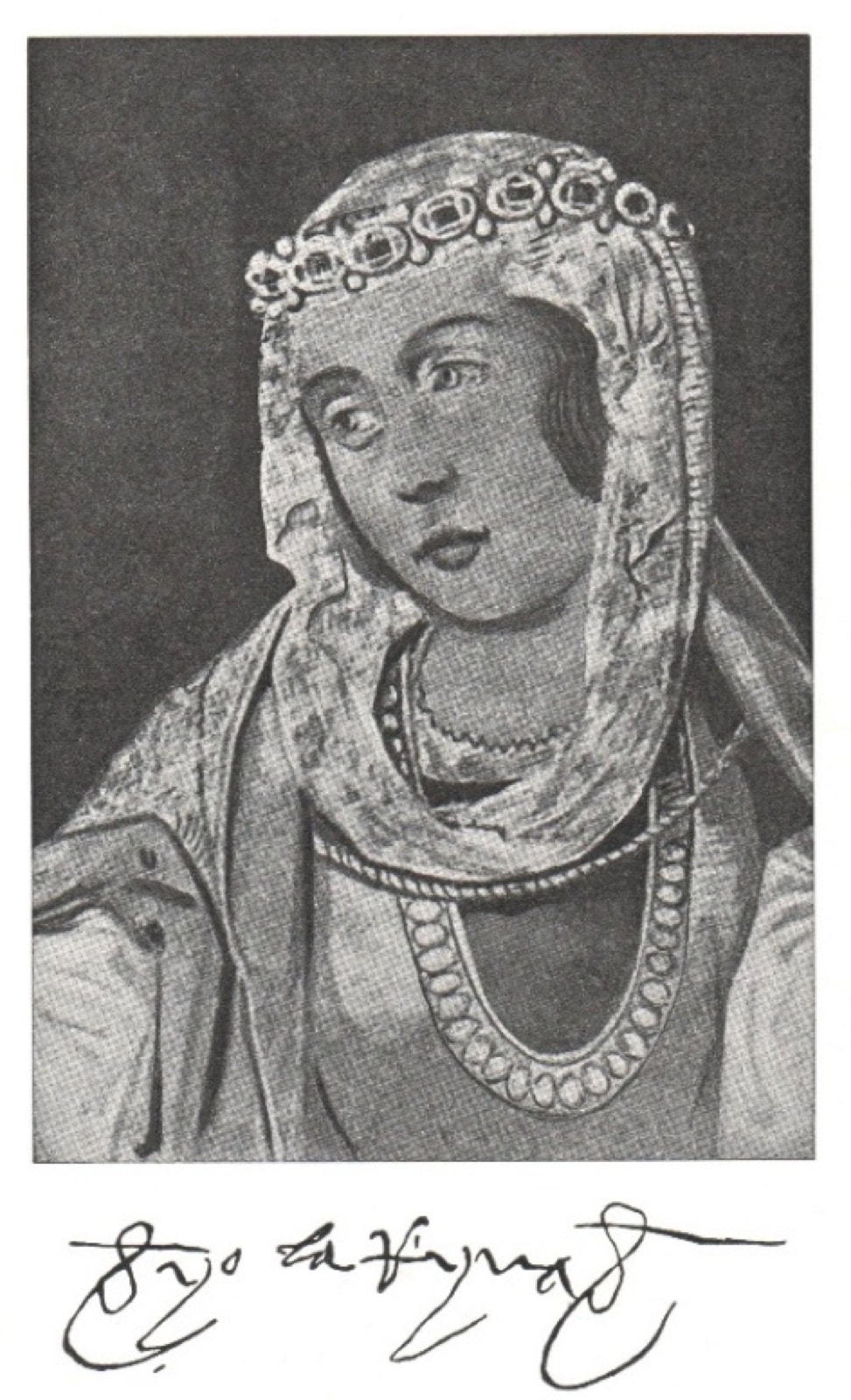
I believe it more plausible to identify her with D. Joana, the Excellent Lady, for she places her left hand upon her womb to indicate the maternity of the Child Emperor of the Last Days.
Pointing in the same direction are the letters A and Y (Afonso and Joana) concealed in the headdress (hennin).
This is surmounted by foliage resembling flames.
Beneath her dress she wears a green underskirt (hope).
The Excellent Lady was the daughter of Henry IV and of D. Joana, King and Queen of Castile. In Castile she was known as the Beltraneja, since she was said to be the daughter of D. Beltrán de la Cueva and the Queen.
She ended up in Portugal after having, on several occasions, been deemed heiress to the throne of Castile and, as many times, been deprived of that inheritance, until her partisans and, therefore, those of her father, persuaded King Afonso V of Portugal to marry her and thus take possession of the throne of which D. Joana was the legitimate heiress.
King Afonso and his niece set out for the frontier; they entered Plasencia, where they married, in 1475, and there they were acclaimed as Sovereigns, so that there should be no doubt as to possession.
In chapter CLXXVIII (Of how the King arrived at Plasencia, where he was publicly sworn as King, and wedded to Queen D. Joana, and of other matters) of his Chronicle of King D. Afonso V, the chronicler Rui de Pina (1440-1520) recounts what took place:
“And in this array, without any encounter or hostile alarm, the King arrived at the city of Plasencia, where Queen D. Joana already awaited him. And with her the Duke of Arévalo, who were lords of the said city, and with them the Marquis of Villena and the Count of Oroña and many other lords; and the King lodged with the Queen within the fortress, where for some days there were great feasts and pleasures, in which was deliberated the manner of the reception of the King with the Queen, and his raising up as King, which was done upon a high and most rich scaffold set in the city square, on which the King and the Queen both stood together.
And there, after the solemnity of the espousals had been publicly performed, as in such a case was fitting, forthwith with ceremonies of trumpets and kings-of-arms, in loud voices they were, by the lords who were present and by many others holding their proxies, raised up and sworn as King and Queen of Castile, and as such they kissed their hands, and public instruments were drawn up thereof.
And from then onward, the King styled himself D. Afonso, King of Castile and of Leon and of Portugal, etc., and he called the Queen his wife, with whom neither then nor afterwards did he ever consummate the marriage, for want of a dispensation which he did not have nor ever obtained”.
The marriage was not confirmed by the Pope, at the insistence of the Catholic Monarchs, on the argument that they were related in a very close degree, which, moreover, was the case with the Spanish monarchs, related in an even closer degree.
She was betrothed dozens of times before and after her marriage to King Afonso V, but never married again.
By a treaty of alliance between King Afonso V and the King of Castile, the latter imposed the banishment of D. Joana to the monastery of Santa Clara in Coimbra, where “the Excellent Lady” took her vows under duress.
After taking her vows, she abandoned the cloister, on successive occasions, in order to marry, which never came to pass, always returning to take her vows once more.
She styled herself Queen of Castile until her death, but never ascended the throne, having made a donation of the Kingdom, which she never possessed, by testament to King John III of Portugal.
From her marriage to King Afonso V a son was born who lived ever in concealment, since his life was in peril whenever a new marriage for his mother was spoken of.
The depiction of the letter Y (for Yoana = Joana) occurs in Portugal from at least the late twelfth century, appearing in connection with the old interpretation of an emblem representing the dilemma of Man before the choice between Good and Evil. In this sense, the so-called Littera Pythagorae came to be a symbol of Jesus, alluding, of course, to the first letter of His Name, Yesus.
In Portugal, the exegetical and theological tradition of the Littera Pythagorae had as its centre the monastery of Santa Cruz in Coimbra and the Order of the Canons Regular of Saint Augustine. On the seal of D. Afonso Martins, prior-major of this monastery (1399), there appears a Y upheld by two angels performing their office as messengers of the Divine Word.
In lay circles, the Y was used above all by members of the House of Avis, beginning with its founder, who had adopted it because it coincided with the first letter of his name, several coins and tombstones bearing the crowned Y still surviving. Various other members of the same dynasty took up this symbolism; naturally D. João II, but also D. Brites, mother of King Manuel, who made the said letter, set between four mountain ranges, her device.
Outside the Royal House, the Y was also used by members of the nobility, chiefly in the form of a device. Such is the case of D. Fernando de Meneses and his wife D. Brites de Andrade, who adopted the Y as their device, as it is represented on the common tomb at Santa Clara in Vila do Conde.